UFC Live Betting in the UK: In-Play Mechanics and Limits
 Available in US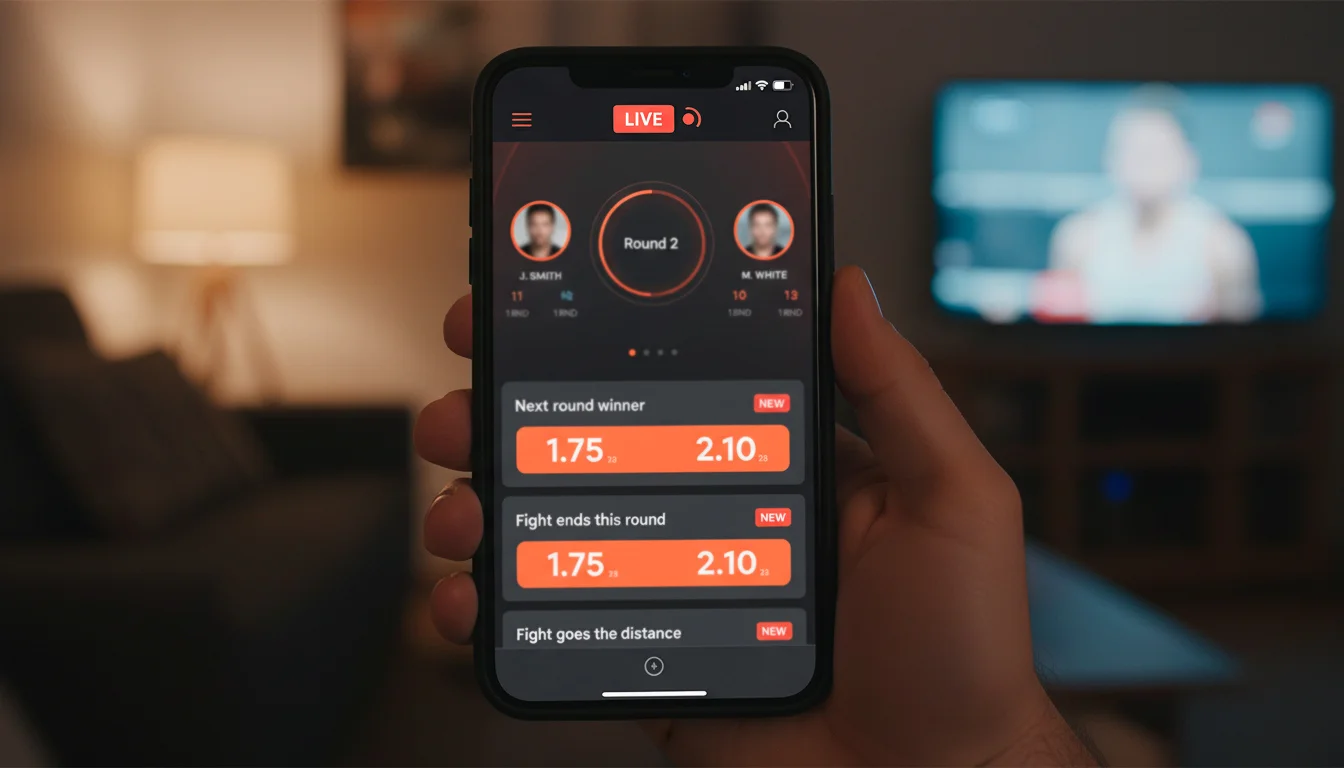
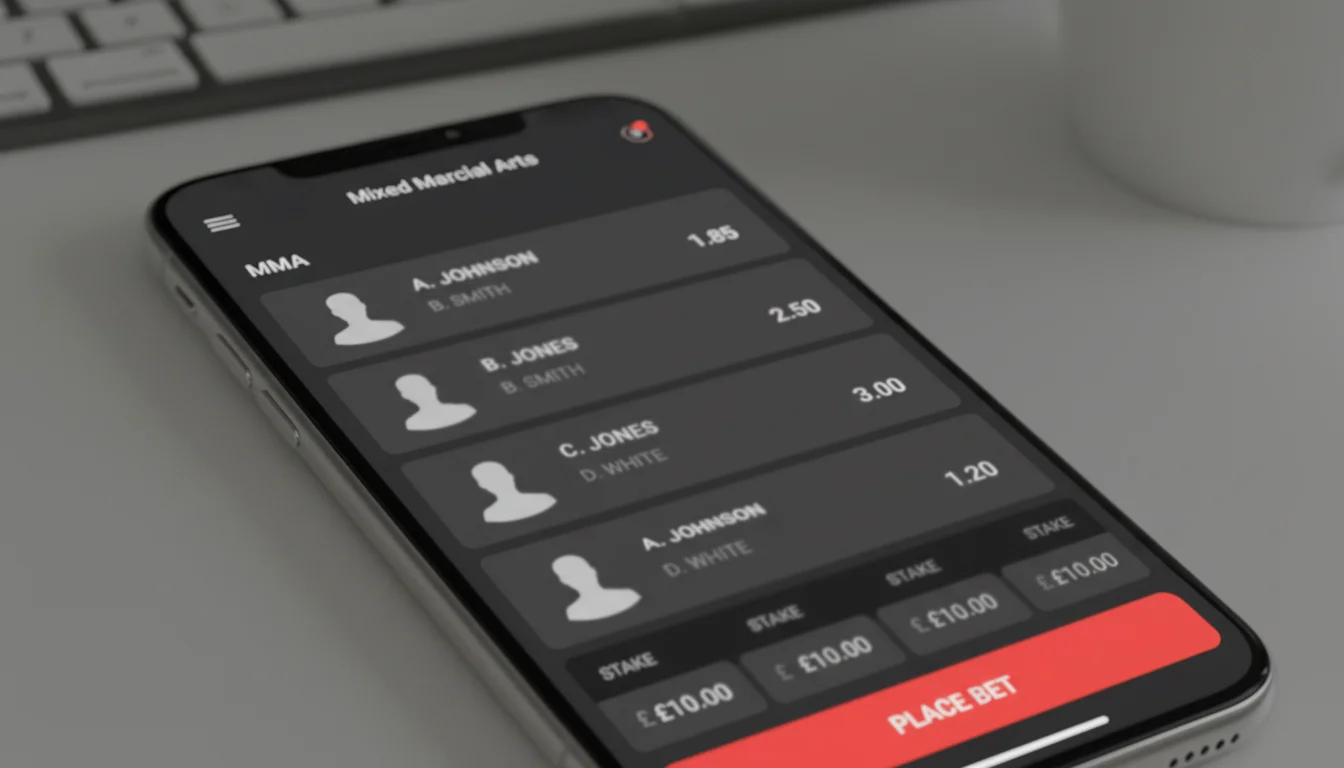
Three in the morning, UK time. Round one has ended. Your fighter ate a knee on the way to the clinch and the commentary team is already writing him off. The moneyline that was 1.85 before the fight is now 3.20 in the live market, and you have about twelve seconds before round two starts to decide whether the body shot was a minor thing or a fight-changer. You tap into the bet builder, stake £30, and spend the next fifteen minutes finding out which it was.
That’s UFC live betting in one scene. 74% of UK in-play wagers are placed on phones or tablets, which tells you everything about when this activity actually happens — late nights, early mornings, one-handed on the sofa. It’s the fastest-moving, most emotionally loaded corner of the UFC betting menu, and the corner most likely to punish a punter who hasn’t thought through the mechanics before kicking off a live session.
How UK Sportsbooks Price In-Play UFC
A UK live-betting desk running a UFC fight isn’t watching the broadcast the same way you are. They’re running a model that takes inputs — round score, fighter positioning, damage, cardio indicators — and outputs adjusted probabilities for the moneyline, total rounds, method of victory, and round-specific markets. When the model updates, the prices on the app update. The gap between your eye’s read of the fight and the book’s model’s read is where every live-betting edge and every live-betting trap lives.
Most UK operators use a mix of automated algorithmic pricing and human trader oversight. The algorithm handles the millisecond-by-millisecond updates as takedowns, significant strikes, and round results come in. The human trader steps in during momentum swings — a knockdown, a submission attempt, a corner’s visible panic between rounds — to adjust the model’s output when it’s moving slower than the reality. The blend means prices feel twitchy at times and glacial at others, and understanding which mode the book is in matters for your timing.
Every round ends with a scoring pause. The book processes the round, updates all dependent markets, and reopens betting. That pause is typically 60-90 seconds in the UK, corresponding to the rest between rounds plus the book’s re-pricing time. If you’re staking at the end of a round, you’re staking into a market that has just digested the most recent data. If you’re staking during a round, you’re staking into a market that’s processing live action and may have latency relative to what you just saw on screen.
Round-by-Round Markets and Refresh Frequency
Beyond the simple moneyline, UK books offer round-by-round markets that reset with each new round. “Next round winner”, “round 2 ends by finish yes/no”, “fight ends in round 2” — all of these prices update as the round progresses, with the book’s model recalculating probabilities based on how the round is playing out.
The most actively traded round-by-round market is “will this round end in a finish”. It’s also the market where the book’s model is most transparent. At the start of a round, the price might sit at 8.50, implying roughly 11.8% finish probability. Three minutes into the round, after one fighter has landed a significant combination, the price drops to 4.00 (25%). The book has updated its model based on the strike activity and damage proxy, and the price tells you what the model now thinks.
If you disagree with the model, the price is betable. If the model says 25% but your eye says 40% — you can see that the damaged fighter is fading and the attacker is about to land cleanly — you have a live-betting edge to press. The opposite also holds: if the model says 40% and your eye says 25% because the apparent damage isn’t actually real, the market is paying you to fade.
Refresh rates vary between UK operators. Some books update round-by-round prices every 10-15 seconds during the round. Others update only on discrete events — significant strikes, takedowns, reversals. The difference matters when you’re trying to catch a price before it moves. A book with slow refresh means you can sometimes buy at stale prices after a meaningful event; a book with fast refresh will have already moved on. Knowing your operator’s refresh pattern is an underrated piece of live-betting discipline.
Cash Out: Reading the Partial-Stake Offer
Cash-out is the feature that makes live betting psychologically tolerable and, occasionally, mathematically stupid. The sportsbook offers you a partial settlement of your live bet — lock in some profit now instead of waiting for the full outcome. On a moneyline bet that was placed pre-fight, you might be shown a cash-out value that represents 70-85% of the theoretical fair value based on current live prices.
The maths on cash-out is straightforward once you understand it. If you backed Fighter A at 2.50 pre-fight, and Fighter A is now priced at 1.50 in the live market after winning round one, the theoretical break-even cash-out would be roughly the stake times the pre-fight price divided by the current price. For a £100 stake that was a £250 potential return, if the current price is 1.50 (implied 66.7% probability), the “fair” current value is about £167. The sportsbook will typically offer you somewhere around £140-£150, keeping the difference as cash-out margin.
That 10-15% cash-out margin is your cost for exiting the market early. For a punter who’s confident in their original read, cashing out means giving up value to reduce variance. For a punter who’s watching the fight go badly and feels panicked, cashing out is paying a premium for peace of mind. Both are legitimate reasons, but they’re different decisions.
The most common live-betting trap is asymmetric cash-out behaviour. When a bet is going well, punters tend to cash out to “lock in profit” — giving up expected value to reduce variance. When a bet is going badly, punters tend to let it ride — taking on additional variance in hope of a recovery. Over time, this pattern is net-negative: you’re systematically cashing out of your winners and letting your losers run. A disciplined approach cashes out based on current probability estimates versus remaining upside, not based on emotional state.
Latency and Suspensions: Why You See the Odds Freeze
UFC underdogs win around 35% of fights historically, which means live markets spend much of their time pricing fights that are leaning toward the favourite but not committed. When a significant event happens mid-round — a knockdown, a clean submission attempt, a cornerman showing urgency — the live market often suspends for a few seconds while the trader re-evaluates.
During a suspension, you can see the prices but you can’t place a bet. The button is greyed out. This is by design. The sportsbook is protecting itself against a punter who saw the event on their broadcast a half-second faster than the book’s data feed registered it. That half-second matters because UFC broadcasts have variable delay — your Sky Sports or TNT feed might be 3-5 seconds behind the live action, and your mobile stream might be 15+ seconds behind.
If your feed is delayed and you’re trying to bet against the book’s updating price, you’re going to lose. The book’s model updates on the underlying action, not on what you’re watching. By the time you see a knockdown on TNT, the book has already processed the knockdown, shifted the probability, and either suspended the market or reopened at new prices. You can’t arbitrage a broadcast delay against a real-time market. Experienced live punters accept this and focus on building reads that don’t depend on tick-by-tick action.
Takedown attempts are a common suspension trigger. When a takedown is in progress, the book doesn’t yet know whether it’s a clean finish (which would dramatically shift probabilities) or a failed shot (which would shift them differently). Rather than price in the middle of uncertainty, the book suspends for a few seconds until the situation resolves. If you’re trying to trade an in-progress takedown, you’re usually too late by the time the market reopens.
Staying Disciplined While Betting Live
The psychology of UFC live betting is uniquely hostile. You’re watching your stake resolve in real time, under bright lights, with a commentator telling you a story about the fight that may or may not match what’s actually happening. Every round ends with a scoring pause that gives you time to reconsider your position, and every scoring pause is a temptation to bet more to “correct” what you think went wrong.
The UKGC has been increasingly vocal about consumer protection in rapidly-changing markets. “The consumers who are spending the most on gambling were between two and four times as likely to have a debt management plan as the rest of the credit-check population,” Andrew Rhodes, Chief Executive of the UK Gambling Commission, said in a 2025 speech. Live betting creates exactly this spending pattern — small stakes compounding across rounds, often on late-night cards when judgment is already tired.
Practical discipline for UK live-betting sessions starts with a pre-set cap. Decide before the opening bell how much you’re willing to stake across the full fight card, and commit to it. If you blow through the cap by round two, stop for the night. The market will be there tomorrow. It does not need your money more than you need your money.
A second discipline is single-fight focus. Live betting on multiple simultaneous fights — by flipping between prelims and main card on different tabs — is a recipe for decision fatigue. Pick one or two fights per card where you have a genuine read, bet those lives, and watch the rest without a wallet open. The edges thin fast when you’re trying to handicap fights in parallel.
A third is the cool-down rule. If you lose a live bet in round one, do not immediately rebet the same fight in round two to “chase” the loss. Take the full round-break pause — the 60-90 seconds the book gives you to process — and then make a decision based on what the round actually showed, not on your need to recover. Chasing losses is the single fastest way a disciplined night of UFC betting unravels into a costly one. The operator landscape varies in how aggressively live features are pushed; pick the one where your own discipline lines up with the interface, not the other way around.
The Discipline That Survives the Morning After
Live UFC betting is thrilling, and that’s its danger. The markets update fast, the stakes feel small, and the feedback loop from bet to result is instantaneous. All of that makes for great entertainment and poor long-term profitability unless you’re running a stricter rulebook than the sportsbook is.
Treat every live stake as a probability estimate compared to the book’s implied probability. Skip markets where your edge isn’t clear. Cash out on process, not panic. Respect the pre-set cap for the night. Accept that broadcast delay means you can’t out-arbitrage the book on fresh events. And when the night goes well, don’t confuse good variance with a sustainable edge. The line between the two reveals itself across months, not one good Saturday.
Why do UK UFC in-play markets suspend during a takedown attempt?
The sportsbook’s pricing model can’t resolve whether the takedown will succeed or fail, and the probability implications differ sharply between the two. Rather than price into uncertainty, the book freezes the market until the grappling sequence resolves and the model can accurately update. You’ll usually see 5-15 seconds of suspension during meaningful grappling moments.
Is the cash-out value ever better than the break-even on the live price?
Almost never. Sportsbooks apply a margin of roughly 10-15% to cash-out offers, meaning you give up that value in exchange for locking in a position early. The rare exceptions are cases where the book’s model has lagged behind a fast-developing situation and the cash-out price hasn’t yet been updated, but these windows close within seconds.
Written by the editors at ufc bet Online.