UFC Prop Bets: FOTN, Performance Bonuses and Novelty Lines
 Available in US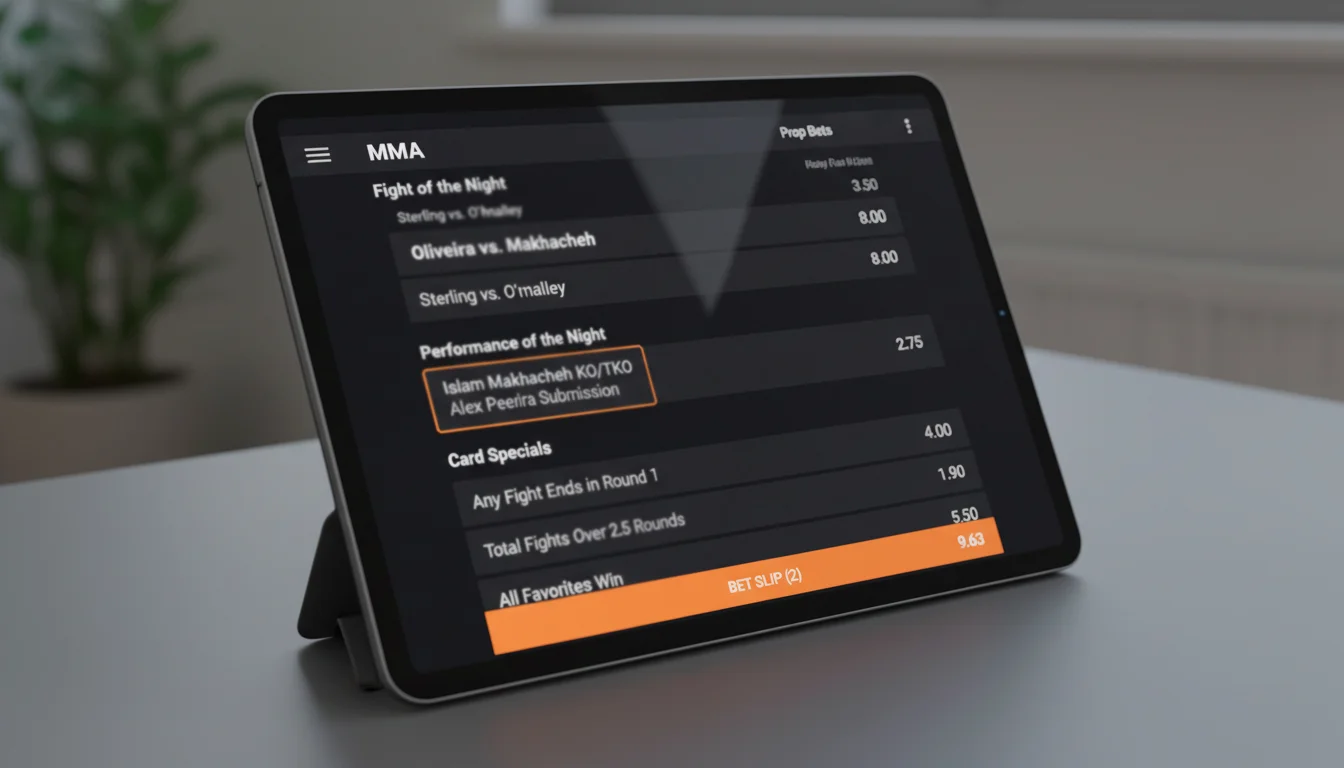
Dana White does the bookmakers no favours. On every pay-per-view, he stands at the press conference podium and loudly announces who’s getting the Fight of the Night and Performance of the Night bonuses — and he’s doing it earlier and more bluntly than ever. “Bonuses are obviously going up,” he said at a Contender Series scrum in August 2025. “Forget about the tide rising with all the other fighters, just the number that the bonuses bring to a fighter is millions of dollars.” That attitude has turned the bonus announcements into genuine, fight-shaping events, and it’s turned UFC prop betting into one of the weirder micro-markets on any UK sportsbook.
Prop bets are where the sportsbook stops being a market and starts being a carnival. Some of the props are sharp, considered markets that require the same handicapping discipline as method of victory. Others are glorified coin flips with a 15% margin stitched in. Learning to tell them apart is the whole skill.
Fight of the Night: How Operators Pick the Field
The Fight of the Night bonus is UFC’s post-event award for the most entertaining fight on a card. It’s announced at the post-fight press conference — usually late in the UK evening — and carries a bonus payment that’s reportedly climbed well above six figures. The betting market opens in the days before the event, lets you pick which fight will win the bonus, and settles immediately after the announcement.
The way UK sportsbooks structure this market is simple: every fight on the main card and prelims is listed as a separate selection, each with its own price. A three-round war between two known brawlers might sit at 3.50. A heavyweight main event between two wrestlers who’ll spend three rounds in clinch work might drift to 25.00. The book’s pricing essentially tries to predict which fight will deliver the most visible entertainment — knockdowns, back-and-forth exchanges, a finish in the dying seconds, a comeback from a near-submission.
The edge in this market lives on prelim fights between two lower-ranked but aggressive finishers. The main card carries a natural pricing premium because punters assume the headliners are more likely to win bonuses — but UFC’s bonus panel consistently awards FOTN to undercard wars. Any time I see two flyweights or bantamweights on the prelims with matching aggressive styles and no defensive wrestling instinct, I check the FOTN market. Prices in the 8.00-15.00 range on genuine fight-of-the-year candidates happen more often than they should.
The edge fades fast on two specific types of fights. One is the dominant wrestler matchup, where one fighter is simply going to grind out a decision with no fireworks. The other is the heavy mismatch, where one fighter is finishing the other in under three minutes and there’s no chance for exchanges. Those fights are usually priced long for a reason, and chasing them because the price looks tempting is a mistake.
Performance of the Night: Finish-Heavy Props
Performance of the Night is awarded to two fighters per event — typically the most memorable individual performances, which usually means knockouts and submissions. The bet works the same as FOTN in structure: each fighter on the card is a separate selection, with prices set according to their likelihood of producing a bonus-worthy finish.
Where this market gets interesting is that POTN strongly favours specific fighter profiles. Fighters who finish opponents with a single memorable strike — a spinning back kick, a flying knee, a walk-off KO — nearly always get selected over fighters who win by workmanlike ground-and-pound or extended submission chains. The bonus is about spectacle, not dominance. A decisive decision win, even if it’s one-sided, essentially never wins POTN.
That means the market rewards specific style reads. A fighter with a flashy striking arsenal against an opponent with a chin vulnerability is a natural POTN candidate. A wrestling-heavy fighter who grinds out decisions, even if they’re winning their next fight decisively, is almost never a POTN pick. UK sportsbooks sometimes price these by win probability rather than by finish-and-spectacle probability, which creates pricing disconnects worth exploiting on fighters known for highlight-reel style.
An angle worth considering: POTN bets on heavy favourites in finishing-favourable matchups are often over-priced relative to their actual hit rate. A 1.50 favourite priced at 4.00 for POTN implies roughly 25% probability of winning the bonus, which seems low until you remember that the bonus goes to two fighters total — and there are typically twelve to fourteen fights on a full card. Even a perfect style matchup gives any single fighter maybe a 15-20% chance of landing one of the two bonuses. The market tends to overprice the obvious finisher precisely because that’s where recreational money flows.
Card-Level Props: Fastest Finish, Total KOs
Moving further into exotic territory, card-level props aggregate outcomes across all fights on an event. “Total number of KOs on the card over/under 3.5” is the classic example. “Fight with the fastest finish under 60 seconds yes/no” is another. “Number of decisions on the card over/under 4.5” is a third.
These markets are priced from historical base rates — the 2021 peak of 55.41% UFC decisions being the reference point against which any given card is modelled — adjusted for the specific matchups on that event. The book looks at the stylistic composition of the card, checks how many fights project to finish versus go the distance, and sets a line.
The edge in card-level props is real but requires doing your homework across all twelve fights, not just the main event. If you’ve identified three matchups on the prelims where both fighters are clear finishers with defensive holes, and the main card has two five-round fights likely to go to decisions, you can build a model of the card’s expected finish rate and compare it to the sportsbook’s line. UFC favourites winning 72% of fights in 2024 is the backdrop — but finish rates by weight class and matchup vary enough that a well-researched card-level read can produce clear edges.
The risk is that card-level props depend on events you can’t control. One cancelled fight at the weigh-ins can blow up your total-KOs bet. A short-notice replacement can turn a predicted war into a mismatch. These markets settle based on what actually happens, so you’re absorbing all the operational chaos of a UFC card in addition to the handicapping question.
Novelty Lines: Walk-Out, Opener Song, Crowd Cutaways
Every year, one or two UK operators decide to push the novelty envelope with UFC. I’ve seen markets on which fighter will remove their mouthguard first between rounds, whether a fight will be interrupted by a crowd member, which Octagon girl will hold the round-one card, and whether a specific fighter will wear shorts of a specific colour. These are not markets in the serious sense — they’re marketing hooks designed to generate social media shareability.
The fundamental problem with novelty props is that they’re non-replicable. Standard sports markets have years of data on base rates and fighter tendencies. Novelty markets have one data point per event, if that. The book sets a price based on vibes, and you’re betting based on vibes. There’s no real edge, just volatility dressed up as entertainment.
If you must play novelty props, treat them strictly as entertainment spend. Never stake more than you’d pay for a cinema ticket. Never combine them with serious markets in a bet builder. And recognise that the book’s margin on novelty is often 20% or higher, because the book knows these tickets are recreational and prices them accordingly. The phrase “dead money” exists for a reason, and novelty markets are often where it lives. UFC underdogs win around 35% of fights — a real base rate based on thousands of bouts. There’s no equivalent base rate for “which fighter gets their hand raised first in celebration”, and pretending otherwise is magical thinking.
Stake Limits on Props and Why They’re Lower
Walk into any UK sportsbook’s UFC section and you’ll notice that main-market limits — moneyline, method of victory, round betting — run into the hundreds or thousands of pounds per bet. Prop limits are frequently capped at £25, £50, or £100. Sometimes lower on novelty lines. This isn’t an accident.
The sportsbook models moneyline confidently because there’s abundant data and liquidity. Props are modelled thinly — sometimes from a handful of historical data points — and the book knows the prices could be wrong by 5% or 10%. The stake cap protects against a sharp punter who has correctly identified a mispriced prop from hammering it at full size. Small limits also reflect the thinner overall liquidity in prop markets; the book doesn’t want to absorb one big bet that moves the price for everyone else.
What this means practically: even when you find genuine edge on a prop, you can’t stake into it at the size you would on a moneyline. £50 on a mispriced 5.00 FOTN pick gets you £250 back. The same £50 of bankroll allocated to moneyline staking at a larger cap would get you deeper into an actually efficient market. Prop hunting is intellectually satisfying and occasionally profitable, but it’s bounded by design.
UFC underdog win rates sitting around 35% gives you context for the longer prop prices. A 10.00 prop isn’t inherently more valuable than a 3.00 prop just because the payout is bigger — the sportsbook has priced the probability accordingly. And on many novelty props, the real-world probability of the outcome is genuinely as low as the long price suggests, so the payout reflects the dice roll you’re actually taking.
Prop betting is the fun market, the creative market, the one where experienced handicappers can occasionally spot something the book missed. But it’s also the market with the tightest limits, the fattest margins, and the most tempting distractions from the higher-volume moneyline and method markets where real edges accumulate. Treat props as a small slice of a UFC betting slate, not the main course. The complete markets overview covers how props fit alongside the bigger-picture strategy.
When are UFC Fight of the Night winners announced for bet settlement?
Usually at the post-fight press conference, which in the UK is typically between 5am and 7am the morning after a pay-per-view. UK sportsbooks settle FOTN bets once the UFC formally announces the winners. If no bonus is awarded — rare but possible — most operators void the market.
Why are prop-bet stake limits lower than moneyline limits?
Props are priced from thinner data and the book’s confidence in the model is lower. Limiting stake size protects the sportsbook from a sharp punter hammering a mispriced prop, and also reflects thinner overall liquidity in these markets. £25 to £100 caps are typical on UFC props across UKGC-licensed operators.
Prepared by the ufc bet Online editorial staff.