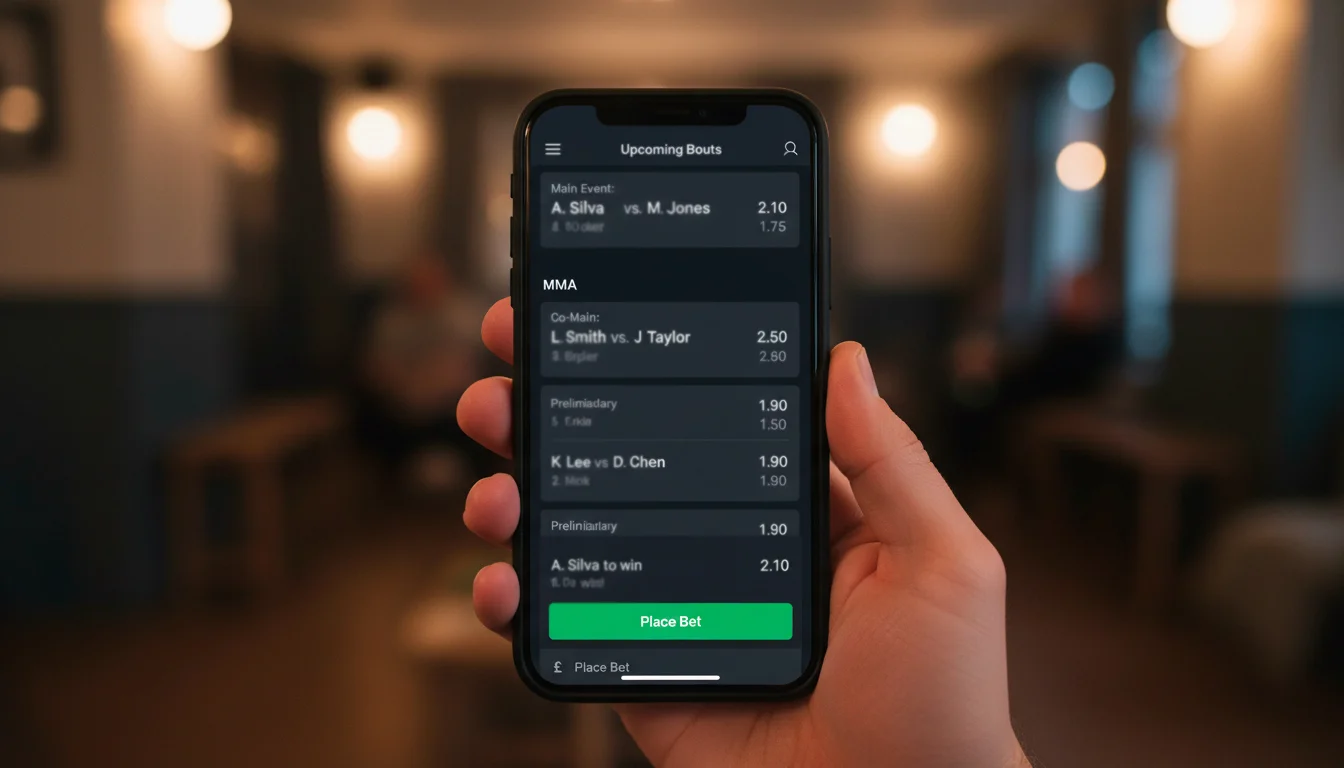
UFC Betting Sites in the UK: A 2026 Ranking Framework
 Available in US
The first UFC ranking list I wrote, about ten years ago, had nine bookmakers on it. Six are gone, rebranded, or no longer take UK customers. Every time somebody asks me for “the best UFC betting sites in the UK”, they’re really asking a question with a shelf life measured in months, not years.
This isn’t going to be one of those pages. No numbered list with five logos and a stamp of approval. Most of the lists you’ve already scrolled past today rank operators by which affiliate deal pays out hardest this quarter, written by people who’ve never placed a bet on a UFC prelim card.
What I can do — what I’ve spent a decade doing — is hand you the framework I actually use when a new bookmaker pops up. Seven criteria weighted by what matters on fight night. A UKGC licence check you can do yourself in ninety seconds. A definition of “good market depth” that isn’t just “lots of logos on the page”. And the red flags that tell me to close the tab before my card ever gets near the deposit field.
The framework is deliberately UK-specific. American lists don’t help here. The UK banned credit cards for gambling in 2020. In-play is overwhelmingly mobile — 74% of UK in-play wagers happen on a phone or tablet. And the UKGC is the most detailed regulator in Europe for what a licensed sportsbook can and can’t do with your deposit.
There’s a pillar on this site — the full 2026 UK UFC betting handbook — that covers the wider picture: tax reform, bet types, odds reading, bankroll. What follows is narrower. It’s the framework for ranking a UK UFC sportsbook, one that survives long after any fixed ranking on the internet has gone stale.
Table of Contents
- How We Score a UK UFC Sportsbook
- The UKGC Licence Check You Should Do First
- MMA Market Depth: What Good Coverage Looks Like
- Live In-Play: Where UK Sportsbooks Diverge Most
- Mobile-First: App vs Browser for Fight Night
- Payments, Withdrawals and Limits
- Odds Competitiveness: Margin Maths for UFC Bouts
- Red Flags: When to Close the Tab
- A Framework, Not a Fixed Ranking
- Questions I Get Asked After Every Fight Night
How We Score a UK UFC Sportsbook
A mate of mine once told me he picks a bookmaker the same way he picks a kebab shop. “If the queue looks right, I’m in.” I respect the honesty. I don’t recommend the method.
Here’s the seven-criterion framework I actually use. Each gets its own section below:
- UKGC licence and licence class — 25%. If this fails, nothing else matters. Remote betting or combined licence, listed on the public register, not a white-label with a thin wrapper.
- MMA market depth — 20%. Moneyline is table stakes. Method of victory, exact round, group round, over/under rounds, bet builder, props. Twenty-plus markets on the main event is my threshold for “deep”.
- Live in-play quality — 15%. Round-by-round lines, refresh speed, mid-action suspension frequency.
- Odds competitiveness — 15%. Overround on a main event moneyline. Industry typical 103–108%; above that and you’re paying rent.
- Mobile UX — 10%. 74% of UK in-play sits on a phone. Bet-slip responsiveness, biometric login, controllable push notifications.
- Responsible-gambling tools — 10%. Deposit limit, loss limit, time-out, reality check, GamStop integration. Visible and friction-free.
- Withdrawal speed and payments — 5%. Smallest weighting because most UK-licensed operators cluster in a narrow band. When one falls off, it falls off badly.
Weights are mine. They reflect a UK UFC-focused punter who cares about live markets and depth more than an accumulator merchant chasing acca insurance. If you live in-play during fight nights, bump criterion three. If you only play main-event moneylines, four matters more than two. The framework is the scaffolding; the weights are yours.
One anchoring number. Active online gambling accounts in Great Britain sat at 24.4 million at the end of 2024/25, with new registrations down 4.1% year on year. The market is saturated, not growing — which means bookmakers still aggressively onboarding new UK customers are most likely to squeeze margins or play games with promo terms.
The UKGC Licence Check You Should Do First
I’m going to ask you to do something that takes under two minutes and almost nobody does. Open a new tab. Google the UKGC public register. Paste the bookmaker’s trading name in. See what comes back.
That’s the check. The number of accounts I’ve saved friends from opening by doing this in front of them is mildly embarrassing.
The Commission currently licenses 2,179 operators and roughly 19,300 personal licence holders — figures from its own consultation documents published in early 2026. Every legitimate UK-facing sportsbook sits in that first list. If you search and get nothing back, or the trading name matches an entry under a different parent than the one plastered on the homepage, stop.
A detour on white-labels. A white-label is a company running a betting site under its own brand but sitting on somebody else’s UKGC licence. Not automatically sinister — plenty of smaller, reasonable operators use the model. But if something goes wrong, your complaint escalates to the licence holder, not the brand on the tin. For UFC, where withdrawal disputes around disputed outcomes (split decisions, overturned results, reviewed knockouts) genuinely happen, you want the chain of accountability short. If a bookmaker is white-labelled and makes it hard to find the licence holder, that’s a quiet no.
One name you’ll see is the Betting and Gaming Council, the UK’s industry trade body. BGC membership is a plus, not a substitute for a UKGC licence. The BGC runs the voluntary code on advertising standards, safer-gambling messaging and the whistle-to-whistle ban. In Andrew Rhodes’s words as the Commission’s chief executive, “total gross gambling yield is at its highest ever level at £15.6 billion. Participation in gambling has remained stable at 48%, just under half of the adult population in Great Britain.” A BGC member signals they play in the same sandbox as the big firms. A shorthand, not a seal.
A word on MGA and Curacao licences. The Malta Gaming Authority is a legitimate EU regulator — not a substitute for a UKGC licence if you’re a UK resident. An MGA-only site taking UK customers is either a geoblocking accident or operating illegally under UK law; either way, no UKGC consumer-protection route. Curacao isn’t in the same conversation. Don’t deposit with either as a UK punter.
Do the register check. Ninety seconds. Single highest-value habit a new UFC punter in the UK can build.
MMA Market Depth: What Good Coverage Looks Like
Picture two bookmakers, both with a UFC event showing. Both look busy. On the first, you click through to the main event and get moneyline, over/under 2.5 rounds, nothing else. On the second, the same fight gives you thirty-plus markets including method of victory split six ways, exact round, round group, will the fight go the distance, a bet builder, and a handful of performance props. That’s market depth.
The reason depth matters for UFC isn’t that more markets equals more fun. It’s that UFC is a sport where the simplest market — who wins — is heavily skewed towards favourites. Favourites won 72% of UFC fights in 2024. That sounds like a licence to print money and isn’t, because the prices already reflect it, but it does mean edge increasingly lives in derivative markets: the round, the method, the distance, the correlation plays inside a bet builder. If your sportsbook only offers the blunt moneyline, you don’t have a bookmaker, you have a coin-flip shop.
My threshold for “deep” on a UFC main event:
- Moneyline, both fighters in decimal, plus a no-draw option.
- Method of victory, split six ways — KO/TKO, submission, decision for each corner.
- Round betting — exact round for each corner plus a “goes the distance” market.
- Group rounds — early (1–2), mid (3), late (4–5 for title fights).
- Over/under rounds with a live main-event line (2.5 for three-rounders, 3.5 or 4.5 for five).
- Bet builder with at minimum moneyline plus method plus round combinations.
- A reasonable prop selection — knockdown markets, fight to go to decision, total significant strikes over/under where the bookmaker is confident pricing it.
Twenty-plus markets on the main event is my line. Twelve means the sportsbook is cutting corners. Forty means they’ve likely got a dedicated MMA trader — a meaningful signal about how seriously they take the sport.
Co-main and prelim coverage is the other half. Some bookmakers treat UFC as a “main event only” product: plenty on the top fight, moneyline-only elsewhere. Fine if you only bet main events. If you hunt value on a prelim dog at plus-220, you need depth across the whole card. Before any major card, I spend ten minutes skimming three or four UKGC-licensed sportsbooks counting markets. Not betting, just counting. The numbers are remarkably consistent for a given bookmaker across events — once calibrated, you’ll know which to open first on fight night.
Live In-Play: Where UK Sportsbooks Diverge Most
There’s a particular flavour of misery reserved for watching a fighter wobble his opponent, opening your bet slip, and finding every in-play market suspended for forty seconds. By the time they reopen, the knockdown has happened, the line has moved twelve ticks, your value has evaporated. That gap — between what’s happening in the cage and what your sportsbook will price — is where UK bookmakers diverge most.
Live in-play is the single biggest quality differentiator in UFC betting. It’s also where 74% of UK in-play wagers sit on phones or tablets. The question isn’t whether a sportsbook offers live UFC betting. They all do. The question is how.
Three things I watch for. First, refresh cadence. A main-event moneyline should update every few seconds, not every minute. If the line sits frozen on 1.45 while a fighter is being taken down and nearly submitted, the bookmaker either has a slow feed or has widened their refresh window deliberately. Good products pulse. Bad ones feel like a slideshow.
Second, market suspension policy. Every sportsbook suspends markets during high-leverage moments — takedowns, knockdowns, scrambles. That’s risk management. What I care about is how long they suspend and whether they reopen with a sensible new price. A top-tier UK operator suspends for under ten seconds on most in-round action, fifteen to twenty during finishes, and reopens with a line reflecting where the fight actually is.
Third, depth of live markets. Some bookmakers offer live moneyline only. Others add live round betting, live fight to go the distance, live next round to win. On main events I want live round betting available after round one, because post-round-one line movement creates some of the most interesting price action in the sport.
Cash out — covered properly in the in-play article. It’s a convenience feature, not a profit feature. Good sportsbook offers transparent buffer. Bad one prices it hoping you can’t do the maths.
One UK-specific wrinkle. Live video streaming of UFC through betting apps isn’t a thing in the UK. UK broadcast rights sit with TNT Sports and UFC Fight Pass. A sportsbook can offer a live stats feed or a fight tracker; it can’t offer a video stream of the fight itself.
Mobile-First: App vs Browser for Fight Night
Most UFC pay-per-view cards end deep in the small hours for UK viewers. I mention that because it reframes what “good mobile UX” means. You’re tired. Probably in bed. Trying to punch a round bet in before the cage door opens, with one hand, in the dark. The sportsbook that respects that reality beats the one that doesn’t.
74% of UK in-play wagers happen on phones or tablets, and on a UFC fight night that number is likely higher — very few of us are at the desktop at 3am. Mobile isn’t one criterion among many. It’s the operating environment.
Native app versus mobile browser is the first fork. Native apps give you push notifications, faster bet-slip responsiveness, biometric login, and occasional in-app exclusives. Mobile browsers give you no-install flexibility, which matters if you’re the kind of person who self-excludes via uninstall. For my main UK account I want the app; for a secondary account I sometimes prefer the browser precisely because the friction of typing credentials is a useful speed bump on impulse bets.
Bet-slip speed is what I test first. Open a market, add three selections to a bet builder, change the stake, watch how many hundreds of milliseconds each interaction takes. A snappy app has selections in under 200 milliseconds and stake entry that keeps up with typing. A sluggish one visibly lags on each tap and the bet slip reflows every time you add a leg. In live UFC, sluggish is how you miss the price.
Push notification hygiene matters more than it gets credit for. A good sportsbook lets you toggle notifications by event type — odds movements, results, promos — so you keep the useful ones and kill the noise. A lazy one bundles everything into a single switch.
Biometric login is the detail that decides whether I use an app or leave it on the home screen. Face ID or fingerprint unlock should be default on a reopened app, not buried three menus deep. Once KYC is completed, it should stick.
Responsible-gambling tools on mobile deserve their own paragraph because this is where operators quietly let standards slip. On desktop, setting a deposit limit is two clicks from the account page. On some mobile apps, it’s a five-tap journey through a settings tree nobody finds unless looking. A UK-licensed operator should make RG tools as reachable on mobile as on web — ideally one tap from the bottom nav. I treat mobile placement of these tools as a proxy for how the operator thinks about player protection. The ones that bury them are telling on themselves.
Payments, Withdrawals and Limits
A withdrawal I made in 2020, right after the credit-card ban came in, took eleven calendar days to hit my bank. I chased, was told there was a “pending verification”, chased again, got the money after sending my utility bill for the third time. UK-licensed operator. Still in business. I no longer have an account with them.
Withdrawal speed is the criterion I weight lowest — 5% — not because it doesn’t matter but because most UK sportsbooks cluster in a tight band. When one falls outside that band, it falls badly, and the 5% earns its keep as a disqualifier.
Credit cards have been banned as a deposit method since April 2020. A regulatory hard stop — any UK-licensed sportsbook offering UFC must refuse credit card deposits. If you encounter one that accepts them, close the tab.
What’s left: debit cards (instant deposits, withdrawals 1–3 working days, often cleared inside 24 hours once KYC is complete); e-wallets like PayPal, Skrill, Neteller (faster withdrawals, often within hours; PayPal’s consumer-protection layer makes it my pick for casual UK punters); open banking via Trustly or Pay by Bank (common since 2022, genuinely quicker than debit for withdrawals); bank transfer (slowest but most robust for large withdrawals).
KYC is the invisible bottleneck. Reforms that took effect on 28 February 2025 lowered the financial vulnerability threshold for light-touch affordability checks to £150 per 30-day rolling period. Losing £150 across a month can prompt a frictionless background check against credit reference data. Doesn’t affect most punters, doesn’t leave a mark on your credit file, but can hold up a withdrawal if a flag pops. Complete KYC day one, upload documents in good light, don’t mix first-name conventions between your bank and betting accounts.
Withdrawal limits are worth checking. Operators capping at £5,000 a week are signalling they’re not built for serious liquidity, and you’ll hit further verification on each tranche.
One rule I stick to. If a withdrawal is pending longer than the stated window, I open a conversation in writing — not live chat — the moment the window expires. A legitimate operator responds and resolves. One that goes quiet, asks for a fifth document, or keeps adjusting the timeline is telling you something. The Independent Betting Adjudication Service exists for these disputes, and any UKGC-licensed sportsbook must participate in an approved ADR scheme.
Odds Competitiveness: Margin Maths for UFC Bouts
Two minutes of honesty. For years I told myself the convenience of my main sportsbook outweighed the two or three ticks of worse price I was getting on main-event moneylines. Then I ran the numbers over a full year of UFC betting — and the two ticks had cost me roughly the price of a weekend in Lisbon. Two ticks is real money.
The overround is the number you calculate. For a UFC two-way moneyline, take implied probability of each fighter (one divided by decimal odds), add them; if the sum is 1.00 the market is perfectly fair. It won’t be. The bookmaker’s margin lives in the excess above 1.00. 1.05 = 5% overround, which is where a competitive UK operator should price a main-event moneyline.
Worked example. Fighter A at 1.50, fighter B at 2.60. Implied probabilities 66.7% and 38.5%. Sum 105.2%. Overround 5.2%. Reasonable UK price. Industry median across my tracked sample sits around 4–7% on main events, top tier closer to 3–4%, loose tier above 8%. Historically across UFC, favourites win roughly 65% and underdogs 35% — so betting favourites at a 7% overround means paying a meaningful tax on what’s already a narrow edge.
Prop and method-of-victory markets carry fatter overrounds — often 15–20% — because each leg is individually less predictable. Fine and normal. What matters is that across two operators pricing the same bet, the one with the tighter overround gives you better expected return per bet, every time.
Best Odds Guaranteed is almost never offered on UFC, so don’t factor it in. Price boosts are a different creature — covered in the dedicated article on whether they’re real value or just marketing. A sportsbook with deep, tight-overround main markets plus occasional boosts is competitive. One with shallow markets and a lot of flashy boosts is papering over the main product.
The practical workflow. On any UFC card I care about I have three UK sportsbook apps open. I check the main event moneyline on all three, calculate overrounds, see who has the best line. Over a year, that 30-second discipline is worth more than every bonus code I’ve ever used.
A warning. Some operators advertise one attractive price to headline a card and quietly fatten the overround on everything else. Spot-check three markets across the card: main event moneyline, co-main method-of-victory, prelim over/under rounds. All three tight, the book is competitive. Only the headliner tight, it’s courting casuals with a shop-window price.
Red Flags: When to Close the Tab
Some things are benignly bad — an ugly logo, a confusing menu. Other things are the sportsbook quietly telling you how this relationship is going to end. Any one of these is enough for me to close the tab.
RG tools hidden below three menu layers. A UKGC-licensed operator must provide deposit limits, loss limits, time-outs, self-exclusion and reality checks. The quality signal is how easily you can find them. Andrew Rhodes, the UKGC’s chief executive, put it squarely in his IAGR keynote in October 2025: “the consumers who are spending the most on gambling were between two and four times as likely to have a debt management plan as the rest of the credit-check population, between two and five times more likely to have a debt default in the last 12 months.” An operator that buries RG tools is choosing not to help those consumers.
Bonus terms requiring unreasonable multiples. 10x wagering on a qualifying bet is normal. 40x on deposit plus bonus combined at minimum odds of 1.80, with an aggregate stake higher than you’d ever bet in a month, is a bonus designed never to be redeemed. Read the terms every time — the cleanest tell about the operator’s culture.
Cash-out values that make no arithmetic sense. If your position is truly worth £80, a reasonable UK sportsbook offers cash-out in the low seventies. If they offer £42, that’s a take-my-money-and-leave button. Check once on a winning position against a line you can verify.
MGA-only operators courting UK customers. Slick sportsbook, heavy UK-facing affiliate marketing, holding an MGA licence but no UKGC licence. Do not deposit. No UK consumer-protection route, no ADR obligation, no UKGC enforcement, no GamStop coverage.
Aggressive marketing to recently self-excluded accounts. If you’ve used GamStop or a deposit limit, you should see less promotional friction, not more. An operator spamming “limited time offers” the day your GamStop expires is not one to trust.
The “Withdraw? Are you sure? Here’s 50 quid to stay” pop-up. One-off it’s annoying; repeated it’s manipulative. Good UK operators have dropped this under UKGC pressure.
One subtler final flag. No statement of editorial or trading independence, no publicly named compliance officer, no credible “about us” page. A legitimate operator has humans behind it with UKGC-registered personal licences, willing to be named. If there’s no named compliance lead anywhere, it’s a white-label with a revolving door of licensees — and accountability will be a nightmare if you ever need it.
A Framework, Not a Fixed Ranking
If you’ve read this far, I’ll level with you about what I haven’t done. I haven’t given you names. No top-five list, no ranked table, no “our winner” graphic. That was deliberate, and it’s the single thing most UK “best UFC betting sites” pages get wrong.
A fixed ranking of UK sportsbooks has a half-life of about six months. Operators change promotion mixes. Trading desks get reorganised. A sportsbook with tight main-event overrounds in January can drift to the middle of the pack by July if the parent company reshuffles its MMA book. Affiliate-driven lists lock in at the moment they’re published and decay the same day. What you need isn’t a list. You need the framework to assess any operator that lands on your radar, at any point in time, including ones that don’t exist yet as I’m writing this in 2026.
So here’s the reduction. UKGC licence check in 90 seconds. Market depth on main event plus two prelims. Live in-play with a watch-and-see test during a real fight. Mobile bet-slip responsiveness on your own handset. Overround on a main-event moneyline compared to two other books. RG tools visible and one tap from the home screen. Withdrawal timing on your first real cash-out. Red flags absent. Done.
Run that framework on any sportsbook, any year, and you’ll make your own ranking better than any list a stranger could write for you. For the wider context — tax reform, bet types, strategy, responsible play — head back to the main 2026 handbook.
Questions I Get Asked After Every Fight Night
Three questions I field every couple of weeks, especially before a stacked UFC card.
How do I verify a UK bookmaker’s UKGC licence in the public register?
Go to the Gambling Commission’s public register (gamblingcommission.gov.uk, Business section, Public Register). Search by trading name or parent company. A legitimate UKGC-licensed operator appears with a licence number, class (usually remote betting general or a combined licence), listed activities and status. If the trading name doesn’t match any entry, or the parent company differs materially from what the homepage suggests, stop there. The check takes under two minutes and it’s the single most valuable habit a UK UFC punter can build.
Do UKGC-licensed bookmakers all cover the same UFC markets?
No. A UKGC licence sets rules for how an operator must behave — licensing, RG, advertising, KYC — but doesn’t prescribe which markets it offers. Depth varies meaningfully. A UFC-serious operator lists 30+ markets on a main event, method of victory split six ways, exact round, group round, over/under rounds, bet builder, props. A UFC-casual operator lists 8 to 12 markets, moneyline-heavy, no method-of-victory on prelim fights. Both legitimate under UKGC rules. Only one is genuinely set up for a UFC punter.
Why do in-play UFC odds update differently across UK sportsbooks?
Two reasons, usually combined. First, data feed — different operators buy from different odds feed providers with slightly different latencies between what’s happening in the cage and what the price reflects. Second, the trader’s risk tolerance. Some operators widen their suspension windows aggressively during scrambles or takedown attempts to protect against arbitrage; others keep markets live longer and accept more variance. Two UK sportsbooks watching the same fight can show materially different live prices for brief windows. The practical move is to have two apps open in-play, though never in a way that breaches either account’s terms.
Created by the ”ufc bet Online” editorial team.