UFC Method of Victory: KO, Submission and Decision Markets
 Available in US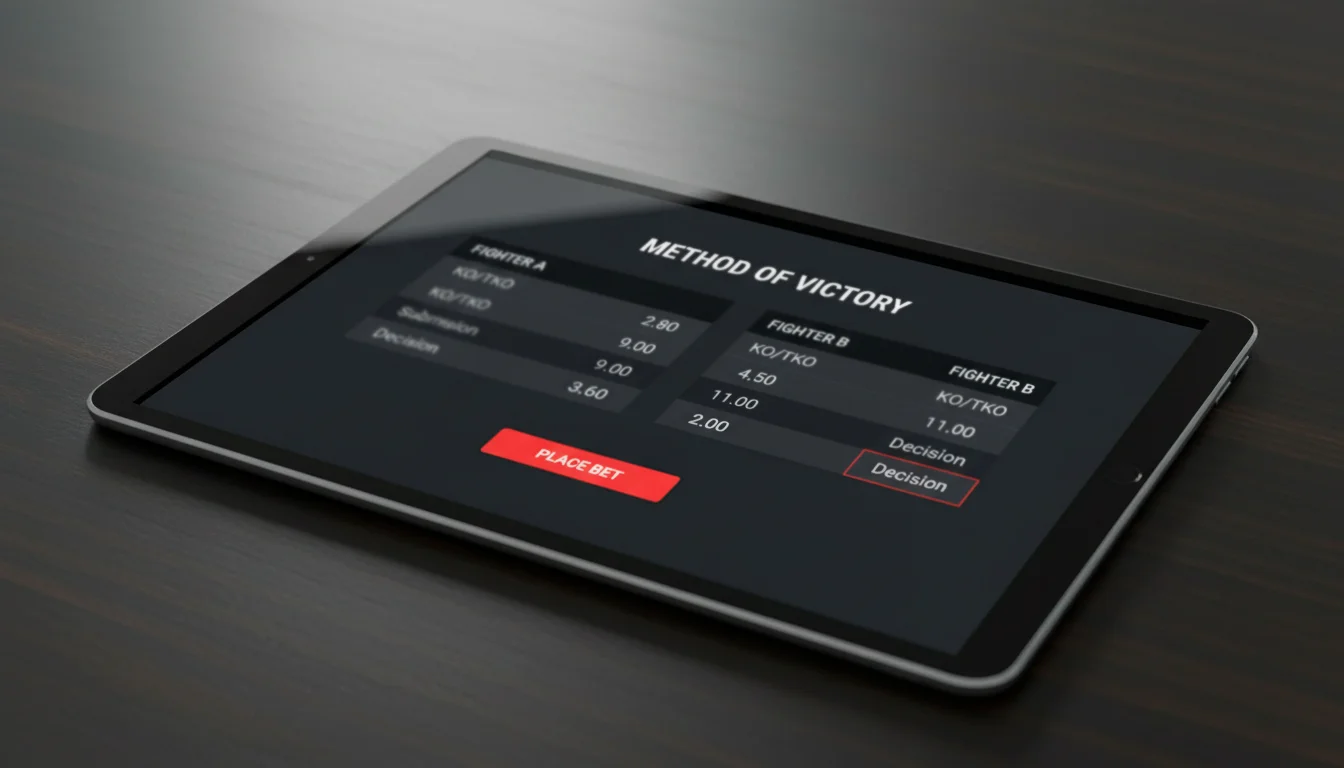
The first time method of victory ever paid me out properly, it was on a welterweight grappler facing a striker with a glass chin. The moneyline was only 1.75 — decent but unremarkable. The method-of-victory line for a submission win on my guy was 4.20. I knew from the tape that he had a high-percentage D’Arce and that his opponent defended takedowns by overcommitting to sprawl. Second round, clinch, Level change, D’Arce, tap. The moneyline would have paid me £75 on £100. The method-of-victory pick paid me £420. Same read, same fight, four times the profit.
That’s the appeal of this market in one paragraph. And it’s also the warning, because the same mechanics that multiply your return when you’re right will punish you just as hard when you aren’t. UFC favourites won 72% of fights in 2024, but method-of-victory favourites win at a much lower rate because you’re now betting on the winner and the how.
The Six-Way Market
Method of victory is almost always offered as a six-way: Fighter A by KO/TKO, Fighter A by submission, Fighter A by decision, Fighter B by KO/TKO, Fighter B by submission, Fighter B by decision. Six mutually exclusive outcomes that must sum to 100% in any honest pricing model. In practice, UK sportsbooks add a bigger overround here than on the moneyline because the downside risk of mispricing one leg is higher.
UFC scoring bundles KO and TKO together into one market. That’s important because TKOs are far more common than clean one-punch knockouts. A referee stoppage from ground-and-pound, a doctor stoppage between rounds, a corner throwing in the towel — all settle as KO/TKO wins on the six-way. Some books split them into a separate “stoppage due to strikes” market for props, but on the standard method-of-victory six-way, they live together.
The same logic goes for the submission line. Technical submissions — where a fighter goes unconscious in a choke without tapping — settle as submissions. Verbal submissions, as rare as they are, settle the same way. A corner stoppage where the fighter was getting submitted counts as a submission in the method-of-victory market on most UK books, though this is the edge case I’d check T&Cs for if you’re betting significant stakes.
Decision covers everything that goes to the cards: unanimous, split, majority, technical decision after an accidental foul in the third round. If the judges score it, decision pays. If the fight is ruled a no contest, the method-of-victory bet voids along with the moneyline.
Decision Rate in UFC: What History Tells Us
The numbers here are worth reading slowly. In 2021, a record 55.41% of UFC fights ended in judges’ decisions — the highest rate in the promotion’s history. That figure dropped in subsequent years as glove rules and promoter tweaks nudged pace back toward finishes, but the ceiling that 2021 set is still the reference point for anyone modelling method markets.
Why does this matter? Because the sportsbook knows this number. If the market prices a “fight ends in decision” prop at 1.90 or 2.00 — implying roughly 50-53% probability — on a fight card where you’d expect the decision rate to be 55% or higher, that’s a systemic edge. The tricky part is figuring out which cards are “decision-heavy” cards. Five-round main events trend toward decisions because you simply have more rounds for either fighter to survive. Matchups between two elite strikers with strong chins tend to go the distance because both can take shots and neither can land a clean finish. Matchups between grapplers who neutralise each other’s takedown games often stall out into positional wrestling that doesn’t produce finishes.
The inverse is equally true. A striker with finishing power against a fighter with a known chin issue? Decision is under-priced there almost every time. A submission specialist facing a fighter whose takedown defence has decayed? Same story. The base rate of decisions is the background — the matchup is what pulls the specific fight toward or away from it.
I pay particular attention to division. Women’s strawweight and flyweight see the highest decision rates because the finishing power relative to opponent durability is lower. Heavyweight sees the lowest — one clean shot at 120 kilos tends to end things. If you’re building a decision model, dividing by weight class gets you 60% of the way there.
Style Matchups for Finish Probability
The Dana White era has pushed bonuses up sharply. “Bonuses are obviously going up,” White said at a Contender Series scrum in August 2025. “Forget about the tide rising with all the other fighters, just the number that the bonuses bring to a fighter is millions of dollars.” Fighters are incentivised harder than ever to go for the finish, which tilts style matchups toward finishes — but only if the style pairing actually permits one.
My shortcut for reading method-of-victory value is to ask three questions about every matchup. First: where does this fight live — striking, grappling, or clinch? Second: who has the power or submission threat in that location? Third: does the opponent’s defence break in that location specifically, or are they defending competently everywhere?
If the fight lives in the striking exchange, and one fighter has one-shot KO power against an opponent with a history of being dropped, the method-of-victory KO line on the striker is often softer than it should be. If the fight lives on the ground and one fighter is a wrestler-top-control grinder against an opponent with no submission threat off their back, the “wrestler by decision” line is frequently the highest expected-value play on the whole card, because the grinder wins but never finishes.
The style read also reveals where the market mis-prices the opponent. If Fighter B is heavily favoured but has never finished a top-fifteen opponent, the “Fighter B by decision” line is probably where you want to be, not “Fighter B by KO/TKO.” Same fighter, same outcome — but the line recognises a finish probability that isn’t supported by history.
Trap Prices: When the Line Overpays the Finish
The biggest trap in method of victory is backing a big underdog to win by KO purely because the price is tasty. Fighter A is 4.50 on the moneyline, but the “Fighter A by KO” line is 11.00. You see the 11.00 and your brain fires off a highlight reel of lucky punches. Price-to-reality misalignment is where this market eats beginners.
Here’s the maths: an 11.00 price implies a 9.1% chance of that specific outcome. For that to be positive expected value, you need to believe this fighter wins by KO at least 10% of the time in this specific matchup. That requires not just a puncher’s chance, but a realistic path to the puncher’s chance — the opponent’s head movement, their footwork, their chin, their tendency to engage in exchanges. If any of those factors closes the door, the 11.00 price is a lottery ticket, not a bet.
Volatile five-round fights create similar traps. A title fight that goes to championship rounds opens up finish paths that wouldn’t exist in a three-rounder — a tired grappler starts getting lazy with submissions in round four, a striker starts getting hit clean in round five once the gas tank empties. The sportsbook prices rounds four and five finishes separately in the round-betting market, and the method-of-victory prices for the underdog can look attractive because the five-round format genuinely does give more chances for an upset finish. But you have to believe the specific fight will actually drag into those late rounds. If it’s a first-round blowout either way, the inflated method-of-victory price on the dog was always mispriced relative to what was likely to actually happen.
A Worked Example at Light Heavyweight
Let’s invent a fight to run the maths. Light heavyweight main event: Fighter A at moneyline 1.55, Fighter B at 2.50. The method-of-victory six-way shows Fighter A by KO/TKO at 2.80, Fighter A by submission at 9.00, Fighter A by decision at 3.60, Fighter B by KO/TKO at 5.50, Fighter B by submission at 21.00, Fighter B by decision at 5.00.
Convert each to implied probability and you get Fighter A KO/TKO: 35.7%. Fighter A submission: 11.1%. Fighter A decision: 27.8%. Fighter B KO/TKO: 18.2%. Fighter B submission: 4.8%. Fighter B decision: 20.0%. Total: 117.6%. That’s a 17.6% overround — much fatter than the moneyline’s typical 5% margin — which is why method of victory is a higher-margin product for books and why you need a stronger edge to play it profitably.
Say you’ve watched both fighters extensively. You know Fighter A is a boxer with heavy hands who’s finished 70% of their career wins by KO. Fighter B is a wrestler who has never been stopped but also hasn’t finished a fight in four outings. Your read says the moneyline is about right — Fighter A wins around 63% — but the path to that win is almost entirely by KO or decision, not submission. You’d rate Fighter A by KO around 42%, Fighter A by decision around 18%, Fighter A by submission around 3%. Compare those to implied: the KO line at 35.7% implied is under your 42% estimate, giving you a clear edge. The decision line at 27.8% implied is over your 18% estimate, so you skip it. The submission line is a trap at any price.
This is the full workflow. You don’t bet every method-of-victory line on the card. You bet the specific leg where your probability estimate is meaningfully above the book’s implied probability, and you skip the rest. Once that discipline is locked in, this market becomes the single highest-edge play on a UFC card for punters who do their homework. Lean on the broader markets overview to see how this slots alongside bet builder and round betting, because the three are usually competing for the same pound of your stake.
How is a method-of-victory bet settled on a split decision?
A split decision settles the same as a unanimous or majority decision. The judges’ scoring splits don’t matter for this market — if the cards go in your fighter’s favour, any ‘by decision’ bet pays out. The only scoring nuance that matters is whether the bout was completed; a technical decision after an accidental foul also pays.
Does a higher decision rate mean the ‘goes the distance’ market is always a better bet?
No. A base rate of 55% decisions is useful context, but individual fights vary wildly. Five-round title fights and matchups between durable fighters push decision probability up; finishing-heavy matchups at heavyweight push it down. Use the base rate as a starting point, then adjust for the specific fight before comparing to the sportsbook’s price.
Published by the ufc bet Online team.