
UFC Round Betting: Exact-Round, Group-Round and Totals
 Available in US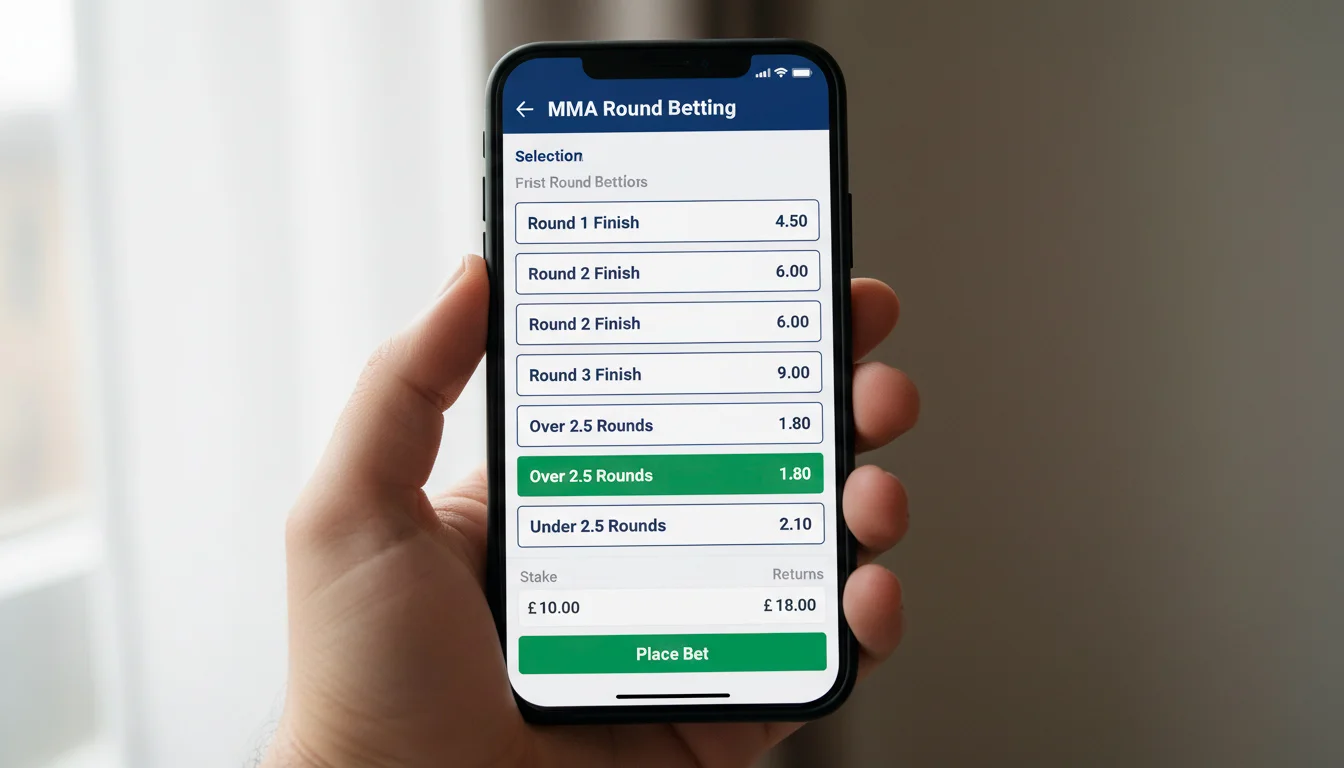
The single cleverest bet I’ve ever seen a friend place was on a welterweight title challenger to win inside rounds four or five. Moneyline was 3.20. Exact-round-four finish was around 18.00. The group-of-rounds line — “fighter wins in rounds 4-5” — paid 9.50. He took the group line at a £30 stake, watched his guy weather three rounds of damage, then drop the champion with a body kick in the fourth. £285 profit on a read that the champion would fade into the late rounds. That’s round betting done right: specific enough to pay well, broad enough to survive one wrong minute.
Round markets are where UFC gets genuinely interesting beyond the moneyline. But they also punish lazy pricing from both sides of the window — punters who confuse “I think he wins” with “I think he wins in round two”, and books that sometimes under-price late-round finishes on five-round main events. The 2021 record of 55.41% of UFC fights ending in decisions is the backdrop, because the flip side — 45% of fights ending inside the distance — is the entire surface area where round betting lives.
Exact Round Markets: High-Variance, High-Price
Exact round betting is the poker all-in of UFC wagering. You’re not just picking the winner, not just the method — you’re picking the specific round where the fight ends. Three-rounders give you three possible exact rounds per fighter. Five-rounders give you five. Combine that with method and you’ve got exotic props that pay anywhere from 8.00 for a heavy favourite in an expected round to north of 40.00 for an underdog first-round KO.
The mechanics matter. A standard UFC decision — by unanimous, split, or majority — is not an exact-round outcome, so exact-round bets implicitly assume a finish. If your exact-round-two pick is winning the fight but the bout goes to a decision, you lose. This is where UFC favourites winning 72% of fights in 2024 gets you nothing, because that figure includes all their decision wins — and those never trigger exact-round payouts.
Pricing exact rounds requires layering three estimates. First, probability your fighter wins at all. Second, probability the fight finishes rather than going the distance. Third, probability the finish happens in the specific round you’ve chosen. Multiply those three probabilities and you get your model’s estimate. Compare that to the sportsbook’s implied probability from the price. If your model number is higher, you have a bet. In practice, exact rounds are nearly always overpriced for underdogs and correctly priced for favourites, which makes them a one-directional market — if you’re looking for exact-round value, you’re usually looking on the favourite side.
Group-of-Rounds: Early, Mid, Late Finish
Group-of-rounds betting is the middle ground between exact and totals. The standard UK groupings are “rounds 1-2 finish” and “rounds 3 finish” for three-rounders, or “rounds 1-2”, “rounds 3-4”, and “round 5” for five-rounders. Some books split differently — “round 1 only” versus “round 2-3” versus “goes distance” — but the logic is the same: you’re betting on the window in which the fight ends.
Where group betting becomes attractive is on matchups where you have a strong read on pace but not on exact timing. A fighter known for fast starts against an opponent with slow defensive adjustments? The “rounds 1-2 finish” group is often under-priced because the sportsbook books both fighters as plausible finishers in those windows, and you only need either to finish for your bet to cash. A championship fight between a durable grappler and a top-heavy striker? “Rounds 3-5 finish” covers both the striker breaking down in the late rounds and the grappler catching a tired submission — two completely different paths, same winning ticket.
The risk profile is friendlier than exact rounds, too. On exact round two, a finish in round one pays nothing. On “rounds 1-2”, both finishes cash. The price reflects that — group lines are shorter than exact — but the hit rate is high enough that group betting is where a disciplined punter can build a long-term edge without the variance whiplash of exact rounds.
Over/Under Rounds and Common Lines by Division
Totals are the round-betting market most people start with. The sportsbook sets a line — “Over/Under 2.5 rounds” on a three-rounder, “Over/Under 3.5 rounds” or “Over/Under 4.5 rounds” on a five-rounder — and you’re betting whether the fight goes longer or shorter than that threshold.
The definition of “2.5 rounds” varies slightly between UK operators, but the standard is: a fight “goes over 2.5 rounds” if 2 minutes 30 seconds have elapsed in round three. Some books use 2:30 exactly, others round down to 2:31. Check your sportsbook’s rules — the difference is small but it matters if a fight is stopped at 2:28 of the third.
Common lines by division tell you everything about how the book models pace. At heavyweight, you’ll routinely see Over/Under 1.5 rounds, because knockouts happen fast at 120 kilos. At bantamweight, Over/Under 2.5 is the default on three-round fights because the pace is higher and durability is greater. Five-round main events at lighter weights often sit on Over/Under 3.5 or 4.5, because the combination of cardio, durability, and five-round pacing pushes fights into championship territory more often than not.
Value in totals usually lives in two places. First, matchups where both fighters have a chin but neither has a dominant grappling game — these drag to decisions far more often than their base rates suggest, making the “over” attractive when the line sits at 2.5 or below. Second, matchups with a clear power discrepancy — a heavy puncher against someone who has been stopped by strikes before. The “under” there is often priced conservatively because the market hedges against a stalling fight, but if the stylistic matchup is clearly finisher-versus-vulnerable, the under carries edge.
The 2021 record of 55% decisions means that on a generic three-rounder, the “over 2.5 rounds” outcome cashes more than half the time. If the line is priced at 1.90 or 2.00, implying 50-53%, that’s close to a coinflip — and you need the specific matchup to lean clearly toward a grinding fight before taking the over.
Five-Round Main Events Change the Maths
The jump from three rounds to five isn’t linear. You don’t just get two extra rounds — you get a completely different fight. Pace changes because fighters know they have five to manage. Game-planning changes because there’s time to adjust. Conditioning becomes decisive in ways it isn’t in a 15-minute fight. And the finish distribution shifts hard toward later rounds.
What this means for totals: a five-rounder with Over/Under 3.5 rounds is essentially asking whether the fight ends before round four. In three-round fights, UFC favourites winning 72% of their fights in 2024 includes plenty of first-round and second-round finishes. In five-rounders, fighters pace themselves, so the early rounds are usually feeling-out rounds, the finishes cluster in rounds three through five, and the “under 3.5” line needs a genuine finisher to hit.
The biggest edge in five-round round-betting markets is on the “rounds 4-5 finish” group or the “fight goes the distance yes/no” prop. Championship fights go to the cards more often than non-championship fights because both fighters know survival to round five is possible. Taking the “goes distance” prop on a championship bout between two well-conditioned fighters is often under-priced relative to the actual historical rate. Taking the “rounds 4-5 finish” prop on a matchup where one fighter is known to fade is arguably the single highest-EV spot in the whole round-betting market.
Where Totals Often Misprice Styles
The one pattern I keep going back to is stylistic cardio mismatches. When you have a fighter with elite cardio against someone with known cardio issues — and the matchup isn’t a clear one-shot KO situation — the line tends to settle based on both fighters’ finishing rates without weighing the cardio gap heavily. Over the course of a 15-minute fight, the cardio difference rarely produces a finish. Over the course of a 25-minute championship fight, it almost always does, whether by decision or by late-round stoppage.
Books also tend to under-price the “goes distance” outcome on matchups between two grapplers who neutralise each other. If neither fighter can initiate a takedown or sweep against the other, the fight settles into clinch work, scrambles, and positional grappling that produces very few finishes. The sportsbook will often set the line at Over/Under 2.5 with both sides priced near 1.90, which under-prices the over given how often these grappling stalemates play out.
The inverse — where totals are usually fair or over-priced on the “under” — is on heavyweight and light heavyweight fights with two known power strikers. The market prices the under aggressively because everyone remembers the highlight reels. But the actual hit rate on “under 1.5 rounds” in those matchups is lower than the price implies, because heavy strikers at the top level tend to respect each other’s power and feel each other out in round one, and the finish usually arrives in round two or later.
Totals is the most heavily modelled market on the UFC board. The books are good at it. The edges are small but real, and they live in the specific matchups where style trumps the generic base rate. Pair this read with the method of victory framework and you’ve got two overlapping lenses on the same fight — often one of them mis-prices something the other picks up cleanly.
Reading the Ledger Before Fight Night
Round betting isn’t where you should start as a new UFC punter, and it’s not where you should park your largest stakes. But it’s the market where experienced handicappers find the steepest edges once they’ve built genuine reads on pace, durability, and cardio. The exact-round line is a premium you pay for certainty about timing. The group-of-rounds line is the compromise between specificity and price. The totals line is the most efficient market but the one with the most systemic biases around style-based cardio and durability gaps.
Know which of the three you’re actually betting, price each of them against your own probability estimate, and skip any market where your read doesn’t clearly beat the book’s implied number. That’s the whole discipline. Anything less and round betting becomes a slot machine with extra steps.
Does the Over/Under rounds line include partial rounds?
Yes. The line is stated in half-round increments for a reason — Over/Under 2.5 means the fight must reach 2:30 of round three (or 2:31, depending on operator) to push past the threshold. Finishes before that timestamp count as under. Check each UK sportsbook’s rules page for the exact cutoff second.
How does a five-round main event’s total typically compare to three-rounders?
Five-round totals sit at Over/Under 3.5 or 4.5 rounds most of the time, because championship pacing and better conditioning push fights deeper than the three-round equivalent. A three-round fight at Over/Under 2.5 is the baseline; a five-round main event is essentially asking whether the fight finishes before round four or five.
Created by the ”ufc bet Online” editorial team.