UFC Betting Strategy for UK Punters: Data, Edges and Discipline
 Available in US
Six months into my second year of serious UFC betting, I realised something uncomfortable. Every winning bet I’d placed could be explained by variance. Every losing bet could be explained by discipline I didn’t have. That realisation — that the wins weren’t mine and the losses were — sent me into a research phase that’s lasted a decade.
Most UFC strategy guides online are rehashed American content, focused on sportsbooks that don’t exist in the UK, referencing tax rules that don’t apply here. This article is different. Written for a UK punter, from a UK regulatory perspective, using 2024-2025 UFC data.
The shape of what follows. The first three sections are about quantitative signals that matter — favourite/underdog hit rates, the champion-as-underdog pattern, and the two single most actionable pre-fight triggers (missed weight and short-notice bouts). The next three are about process — building a stats read, measuring your edge through closing line value, and managing bankroll. The last two are about the psychology of in-play betting and why keeping a log is the single highest-leverage habit in UFC punting.
One anchoring fact. Favourites won 72% of UFC fights in 2024. That’s the highest rate in recent memory. If “back the chalk” was an automatic winning strategy, 72% of chalk hitters would be printing money. They aren’t. The reason why is the core of this article — and the reason why discipline matters more than opinion for long-run UK punters.
A scope note. Individual market mechanics are covered in the markets article. This page assumes you know what those markets are; it’s about how to use them well. The regulation context for the affordability rules mentioned in the bankroll section lives in the UK gambling law article.
Table of Contents
- Favourites vs Underdogs: The Real Hit-Rate
- Champion-as-Underdog: A Narrow but Persistent Edge
- Weight Misses and Short-Notice Fights
- Building a Striking-Stats Read
- Closing Line Value and Line Shopping
- Bankroll and Unit Sizing
- In-Play Discipline: When Live Betting Punishes You
- Keeping a Betting Log
- Discipline Beats Opinion
- Questions I Get From Serious Newcomers
Favourites vs Underdogs: The Real Hit-Rate
A question I get a lot. “If favourites win 72% of the time, why aren’t straight favourite parlays an automatic winning strategy?” Short answer: a 72% win rate on fights priced implied at 70% is almost exactly break-even after the bookmaker’s overround. Longer answer: 72% is a blended average across price buckets that hide more than they reveal.
The numbers. Favourites won 72% of UFC fights in 2024 — the highest in recent years. Historically, favourites win about 65% and underdogs 35% — long-run baselines to anchor on. 2022 and 2023 were closer to 65%. Betting favourites blind in 2022 would have lost money. Betting them blind in 2024 would have been narrowly profitable, if you ignored the overround.
The overround nails blind-chalk to the floor. A typical UFC moneyline carries 4-7% overround at competitive UK books. You pay that every time. If favourites hit 65% and the market prices them at implied 66% after overround, you’re running at -1% expected value per bet.
Where’s the edge? Not in chalk-or-dog, but in price buckets:
- Heavy chalk (-300 and shorter) — win about 85-90%. Implied probability at -300 is 75%. Theoretical edge exists, but stake requirements are enormous and UK book limits kick in.
- Strong favourites (-200 to -300) — win about 72-78%. Market implied about 67-75%. Thin edge possible.
- Moderate favourites (-140 to -200) — win about 60-65%. Close to break-even after overround.
- Slight favourites (-110 to -140) — win about 52-55%. Losing bet after overround on aggregate.
Underdogs are asymmetric. Historical 35% win rate. Heavy underdogs (+300 and longer) hit at 15-20%, which sounds bad but is often +EV because the implied probability at +300 is 25%. Math favours the dog if the hit rate exceeds implied probability even slightly.
Serious UK UFC punters spend disproportionate time on two price ranges: heavy chalk (to evaluate whether the book’s lean is wrong) and plus-money dogs in the +150 to +250 range. The moderate-favourite middle is where you lose money slowly and invisibly.
The 72% aggregate covers all UFC events in 2024. Numbered PPVs have tighter markets because they get more sharp attention. Fight Night prelims are where softer lines live. If you’re hunting edge, the middle of a Fight Night is a more fertile hunting ground than the main event of a numbered card.
Champion-as-Underdog: A Narrow but Persistent Edge
The single most specific statistical pattern I’ve found reliable in UFC betting over ten years. It’s also the one that comes with the heaviest caveat.
The pattern. Across 19 historical UFC title defences where the reigning champion entered as a betting underdog, the champion retained the belt 63% of the time (12 of 19). A persistent edge over a structural market bias — the market tends to price rising contenders as favourites when the champion has shown vulnerability, and the champion tends to win anyway. Experience, the “defender” advantage, and title-fight cardio all seem to matter.
Two caveats. First, the sample is small. 19 cases is enough to notice a pattern but not enough to bet confidently that the next champion-underdog matchup fits. A 63% rate from 19 samples has a confidence interval that comfortably includes 50%. A signal, not a lock.
Second, the pattern is conditional. The 63% figure comes from cases where the champion was already priced as underdog. Strip that out and look at all UFC title defences, champions retain about 55-60%. The champion-as-dog edge is the additional 3-8 percentage points over baseline.
When might this pattern be live? Look for a long-reigning champion facing a younger, surging contender with a highlight-reel finish; media narrative heavily favouring the challenger; champion coming off a close split-decision win; no reported injury or decline markers.
When it isn’t live: champion coming off injury or extended layoff; clear athletic decline — slowing strikes, worsening takedown defence; champion aged 36+ facing a prime-age challenger.
A note on sizing. Because this is a narrow, conditional edge from a small sample, it’s not a bet-big spot even when live. My unit on champion-as-underdog is typically half standard — 0.5% of bankroll rather than 1%. The deep-dive on champion-as-underdog in title defences walks through each of the 19 historical cases.
Weight Misses and Short-Notice Fights
If I could only bet on two pre-fight signals for the rest of my UFC career, these would be the two. They’re not glamorous. But they consistently generate betting edges that beat the overround.
First signal: missed weight. A dataset of 323 UFC fights from 2020 found fighters who missed weight at the weigh-in won only 33% of their fights. Think about that. A fighter you’d otherwise price at 50% — a pick’em matchup — who misses weight drops to roughly 33% true win probability. A 17 percentage-point swing driven by one piece of information that becomes public 24 hours before the fight.
Why does missing weight predict losing so strongly? Three reasons. First, a missed weight often signals a botched weight cut — meaning cardio will suffer. Second, it suggests camp disruption — illness, injury, mental health — the team has been hiding. Third, it carries a purse penalty (20-30% forfeited to the opponent), which creates psychological pressure. None deterministic. All bias against the missed fighter.
The timing is brutal. Weigh-ins happen Friday morning (Thursday evening UK time). Markets reprice within hours. If the fighter who missed was previously a 1.70 favourite, the market often pushes them to 2.20 or longer. That repricing is your trading window. Wake up Friday, see a missed-weight story on a fight that hasn’t fully repriced at your book — that’s your signal.
Second signal: short-notice replacement. The same 2020 dataset showed fighters taking bouts on less than one month’s notice lost 63% of their fights. Short-notice fighters are at a real disadvantage — no dedicated camp, no fight-specific game plan, often a weight cut on little preparation. UFC 311 in January 2025 demonstrated this when Renato Moicano stepped in on short notice against Islam Makhachev after Arman Tsarukyan pulled out. Moicano, a credible lightweight, was subbed in with a few days’ notice and the fight became a showcase for the champion.
The UFC 311 example is a reminder that short-notice fighters are often credible competitors — this isn’t about them being bad. It’s about them being underprepared. A fighter who’d normally be 3.50 to beat a champion might be 6.00 on short notice. More reasonable than the original price, but if the 63% loss rate holds as a baseline, even 6.00 can undersell how likely the favourite is to win.
How I play these. Missed weight: if the market hasn’t fully repriced the missed-weight fighter, I back the opponent at the stale price. If already repriced, I pass — the edge is in the repricing delay. Short notice: I often back the favourite at their fresh, shorter price, because my read is that the 63% loss rate is baked in conservatively by the market.
Full deep-dives: missed-weight signal and short-notice betting.
Building a Striking-Stats Read
A stat that surprised me. In the 2020 dataset of 323 UFC fights, fighters with superior career striking statistics — measured through strikes landed per minute and absorbed per minute — won 72% of their bouts. Not the bigger favourite. Not the moneyline chalk. The fighter with the better striking numbers, regardless of price.
That 72% rate from striking differential is, in isolation, one of the strongest single-variable predictors I’ve seen. But “in isolation” is doing a lot of work.
Key metrics for a basic striking read:
- SLpM — significant strikes landed per minute. UFC average about 3.5. Elite strikers 5.0+. Grinders 2.5 or less.
- SApM — significant strikes absorbed per minute. Lower is better. Under 3.0 is solid. Over 4.5 is a red flag.
- Striking differential — SLpM minus SApM. Positive means more landed than absorbed. Headline number for a quick read.
- Striking accuracy — percentage of attempted strikes that land. Elite 50%+.
Using these blindly, career averages bundle multiple phases. A 35-year-old whose prime SLpM was 4.5 but who’s now at 3.2 will still show a 3.8 career average. Always check the trend, not just the static figure.
Style-dependence is the other caveat. Striking differential matters most in stand-up fights where both want to strike. Against a grappler who wants the mat, SLpM is less predictive. You need takedown defence alongside the striking number.
Free data for UK punters. UFCStats.com is the official database — free, slight lag, complete career histories. Tapology aggregates and adds commentary. For a casual punter, UFCStats is enough.
How I use it in practice. I pull both fighters’ SLpM, SApM and takedown defence for their last five UFC fights (not career averages). Calculate differential. Compare. If the striking-differential edge matches the moneyline favourite, the market is priced about right. If it contradicts the moneyline, that’s a flag worth investigating.
Full workflow: the striking stats article.
Closing Line Value and Line Shopping
If you asked me to pick the one metric that separates serious UFC punters from casual ones, it wouldn’t be win rate or return on investment. It’d be closing line value.
CLV is the difference between the price you got on a bet and the price the same bet closed at immediately before the fight. If you backed a fighter at 2.50 and the closing price was 2.20, your CLV was +14% — you got a better price than the market’s final view. If you backed at 2.00 and it closed at 2.20, CLV was -10%.
Why CLV matters. The closing line reflects the aggregated, efficient information about the fight. Every sharp bettor has weighed in by then. It isn’t perfect, but it’s the best single estimate of the true fight probability. Beating the closing line consistently, even by small margins, is the hallmark of a bettor finding real edges. Losing to it consistently means your reads are being corrected by smarter money as the fight approaches.
Historically across UFC, favourites win about 65% and underdogs 35%, and the closing line reflects these rates faithfully across the sample. A bettor who consistently gets +5% CLV or better is statistically going to profit over large samples. A bettor consistently at -5% CLV will lose, regardless of short-term variance.
How to measure. Before each bet, note the price you took. After the fight, note the closing price across two or three UK-licensed sportsbooks (an average is more robust than a single book). Calculate: (closing implied probability – your implied probability) / your implied probability.
Line shopping is the practical application. Sportsbook A has fighter X at 2.20 and sportsbook B has the same fighter at 2.40, backing B gives you +9% CLV before the fight happens. Across a year, line shopping across two or three books consistently finds 2-4% edge per bet — which, over hundreds of bets, is the difference between profit and loss. Full treatment: CLV deep-dive.
A warning. CLV is a leading indicator, not a profit guarantee. You can have +10% CLV and a losing year if variance works against you. Over 200+ bets, CLV and profit tend to align. Over 50 bets, they can diverge wildly. Track both.
One UK-specific point. Some UK-licensed sportsbooks are more sensitive to sharp action than others. Consistent positive CLV can eventually get your account restricted, stakes capped, or bets refused. Legal under terms and conditions but limits the practical upside. Spread volume across multiple books rather than concentrating on one.
Bankroll and Unit Sizing
I ask every new UK punter who tells me they want to “get serious” about UFC betting the same first question. “What’s your bankroll?” About 60% of them don’t have an answer more specific than “whatever’s in my betting account right now”. That’s the problem, not the start of the solution.
A bankroll is a dedicated, separate pool of money allocated to UFC betting, sized so that losing it wouldn’t affect your living expenses, relationships, or mental health. Not “my current deposit”. Not “what I’m willing to risk this weekend”. A fixed amount with clear boundaries.
Unit sizing. A “unit” is a standard bet size, usually expressed as a percentage of bankroll. Most disciplined punters settle on 1-2% per unit. For a £1,000 bankroll, that’s £10-20. Some stretch to 3% on high-confidence plays. Anything over 5% per bet is not unit sizing, it’s gambling with a narrative attached.
Why flat units over Kelly criterion. Full Kelly sizing — betting a percentage of bankroll proportional to your estimated edge — theoretically maximises growth. In practice, full Kelly requires accurate edge estimates, which almost nobody has. Overconfidence plus full Kelly equals catastrophic volatility. I use fractional Kelly — one-quarter or one-half — when I’m confident in the edge, but flat units as the default.
UFC variance is ferocious. A single bad card can wipe 10-15% of a bankroll even when your reads are sound. Short fights, high variance, single-round outcomes driven by one punch. You size for the variance, not the expected value. A 2% unit that feels tiny on a single bet can still produce a 20% drawdown across a bad five-card stretch. The punters who blow up are the ones who react to drawdowns by increasing unit size to “catch up”.
UK-specific affordability context. The financial vulnerability threshold for light-touch affordability checks at UK-licensed sportsbooks is £150 per 30-day rolling period. Hit £150 of net loss in a month at a single book and you can trigger a frictionless background check. Andrew Rhodes, the UKGC chief executive, put it plainly in a 2025 speech: “the consumers who are spending the most on gambling were between two and four times as likely to have a debt management plan as the rest of the credit-check population, between two and five times more likely to have a debt default in the last 12 months.” That’s not a rule for you; it’s a signal that the regulator is watching the pattern, and a reminder that your bankroll should be money you can afford to lose without it compounding into broader financial harm.
A practical rule I stick to. I set my bankroll at the start of each calendar quarter. I don’t add mid-quarter unless I’ve had a genuine windfall unrelated to betting. I don’t withdraw mid-quarter unless a defined unit target has been hit. The quarter discipline forces me to evaluate performance on meaningful time horizons rather than reacting to last weekend’s results. Full framework: UFC bankroll management deep-dive.
In-Play Discipline: When Live Betting Punishes You
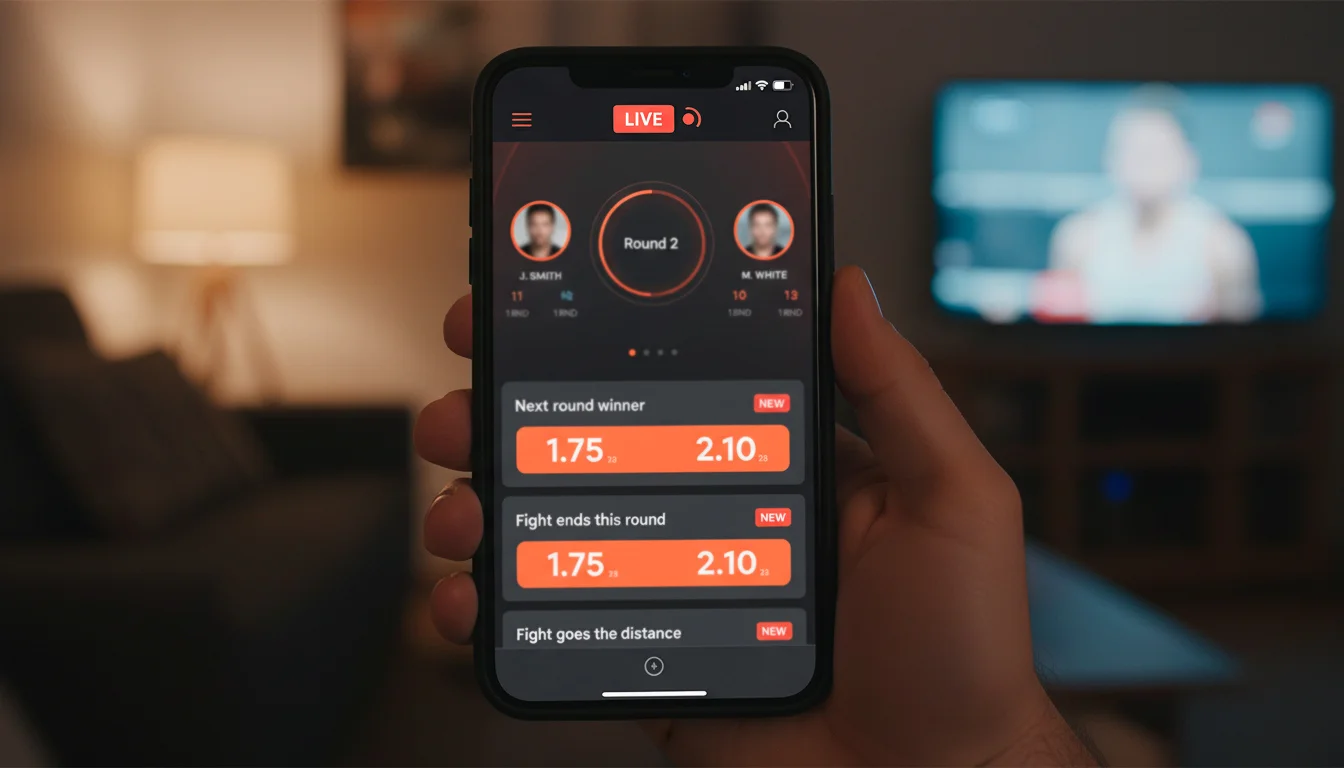
In-play is where most of my worst UFC bets have been placed. I suspect I’m not alone in that. The combination of adrenaline, short decision windows, and markets that feel urgent makes live betting the single most psychologically dangerous format in UFC punting — and it’s where 74% of UK in-play wagers get placed on phones or tablets, which means the dangerous format meets the tempting interface.
Let me describe the pattern I had to unlearn. Fighter I liked pre-fight loses round one decisively. His price drifts from 1.80 to 3.50. My in-play brain says “he’s live, this is value”. I stake another unit at 3.50. He loses round two. I hedge. I lose the hedge. I’ve now lost twice on the same fight because round-one emotion overrode round-one analysis.
The discipline fix. Before the fight starts, I write down — literally on paper or in a phone note — two things: the price I’d re-enter if my fighter loses round one, and the price at which I’d exit if the fight goes against my read. If the live price hits re-entry and my pre-fight analysis still holds, I stake. If not, I don’t.
Market suspensions work against impulse. When a fighter threatens a takedown or lands a knockdown, UK sportsbooks typically suspend the market for 10-30 seconds. Annoying if you’re trying to act on a live read, but structurally useful because it forces a pause between seeing the action and acting on it. Punters who hate the suspension are usually the punters who most need it.
Latency is real. Your TV broadcast is often 3-10 seconds behind what the bookmaker’s data feed is showing. If you see a knockdown on TV and open your app to back the stand-up fighter, the market has already seen that knockdown via its faster feed and the price has already moved. Never trust that your TV view is the first information available.
A cool-down rule I follow religiously. After any losing in-play bet, I wait until the next commercial break or the next fight before placing another live bet. Sounds trivial. It’s the single most effective discipline I’ve built.
Cash out is the related trap. UK-licensed sportsbooks offer cash-out on live positions at a price that includes the book’s cut — usually 5-15% worse than the implied value of the live line. Taking cash-out isn’t always wrong, but it should be a considered decision, not a reflex reaction to being up. If you’re cashing out most winning live positions early, your unit sizing is probably too large for your risk tolerance.
Full discipline framework: UFC live betting article.
Keeping a Betting Log
Every serious UFC punter I know keeps a betting log. Every casual UFC punter I know doesn’t. The correlation isn’t accidental.
A log is a spreadsheet — nothing fancier — where you record every bet as you place it and every result as it happens. My columns: date, event, fight, market, selection, odds taken, stake, unit size, closing price, result, profit/loss, rationale (one sentence), and CLV percentage. Twelve columns. Takes under a minute per bet to populate. The act of logging forces you to articulate why you’re betting, before you place the bet — which kills roughly a third of impulse bets before they leave your thumb.
The real value of the log is in monthly and quarterly review. Pull the data. Look for patterns. Are you profitable on method-of-victory bets but losing on round bets? Do you win more on underdogs than favourites? Does your CLV look different on Fight Night cards versus numbered events? Without the data, all of this is hunch. With it, you can actually see where your edges live and where they don’t.
The review rhythm I use. Weekly: scan the week’s bets, note anything unusual. Monthly: calculate profit/loss, average CLV, win rate, unit size discipline. Quarterly: full review — adjust bankroll, evaluate whether any market type should be dropped from my rotation, check whether my edge is deteriorating.
The rationale column is the one most people skip. Don’t. “Gut feel” is not an acceptable rationale. “Underdog has better SLpM differential and missed-weight favourite fought with no camp” is. If you can’t articulate why you’re taking the bet in one sentence, you shouldn’t be taking the bet.
Discipline Beats Opinion
If you take one thing from this article, let it be this. UFC betting strategy isn’t about having the best read on the next fight. It’s about having a process that survives the weeks where your reads go wrong.
The quantitative signals I’ve walked through — the 72% favourite rate that isn’t what it looks like, the 63% champion retention, the 33% missed-weight trap, the 63% short-notice loss rate — are all real. They’re edges. But an edge without discipline is a leak with better decoration. The bettors I know who’ve been profitable in UFC over five years aren’t the ones with the sharpest reads. They’re the ones who track CLV, size units consistently, keep a log, and don’t chase losses in-play.
Opinion is cheap. Discipline is expensive. For the wider UK UFC betting framework, the 2026 handbook is where everything connects.
Questions I Get From Serious Newcomers
Three questions I get from punters who’ve moved past the “what’s a moneyline” stage and are trying to build a real strategy.
What is closing line value and why does it matter for UFC betting?
Closing line value (CLV) is the difference between the price you took on a bet and the price the same bet closed at before the fight. If you backed a fighter at 2.50 and the closing price was 2.20, that’s positive CLV — you got a better price than the market’s final estimate. CLV matters because the closing line reflects the aggregated view of all bettors, including sharp money, and it’s the most robust indicator of whether your individual reads are beating the market. A bettor with consistent positive CLV will, statistically, profit over large samples. A bettor with consistent negative CLV will lose, regardless of short-term win/loss noise. Track CLV on every bet; it’s more predictive of long-run success than win rate.
How should a UK punter size units for a single UFC card?
Flat units at 1-2% of bankroll per bet, increased modestly to 2-3% only on high-confidence plays. Do not exceed 5% of bankroll on any single bet. On a typical UFC Fight Night with 12-13 fights, you should generally find two to four bets that meet your edge criteria. Staking a full unit on every fight is overbetting — it’s forcing the bet to match the schedule rather than letting the schedule produce the bet. Maintain the same unit size across the whole card; varying stakes without a structured reason is how discipline erodes.
Does a missed weigh-in really change the betting value?
Yes, and measurably. The 2020 UFC dataset of 323 fights showed fighters who missed weight at the weigh-in won only 33% of their fights. That’s a 17-point swing from the implicit 50% baseline you’d assign an average matchup. The edge isn’t in the raw figure though — it’s in whether the market has repriced to account for it. Bookmakers typically reprice within minutes of the news hitting, so the practical window to exploit the signal is narrow. If you can check your sportsbook after the Friday weigh-in and the missed-weight fighter hasn’t moved meaningfully, that’s the window. If they’ve already drifted from 1.70 to 2.30, the market has done the work and the edge is gone.
Prepared by the ufc bet Online editorial staff.