UFC Bet Builders in the UK: Correlation, Pricing and Traps
 Available in US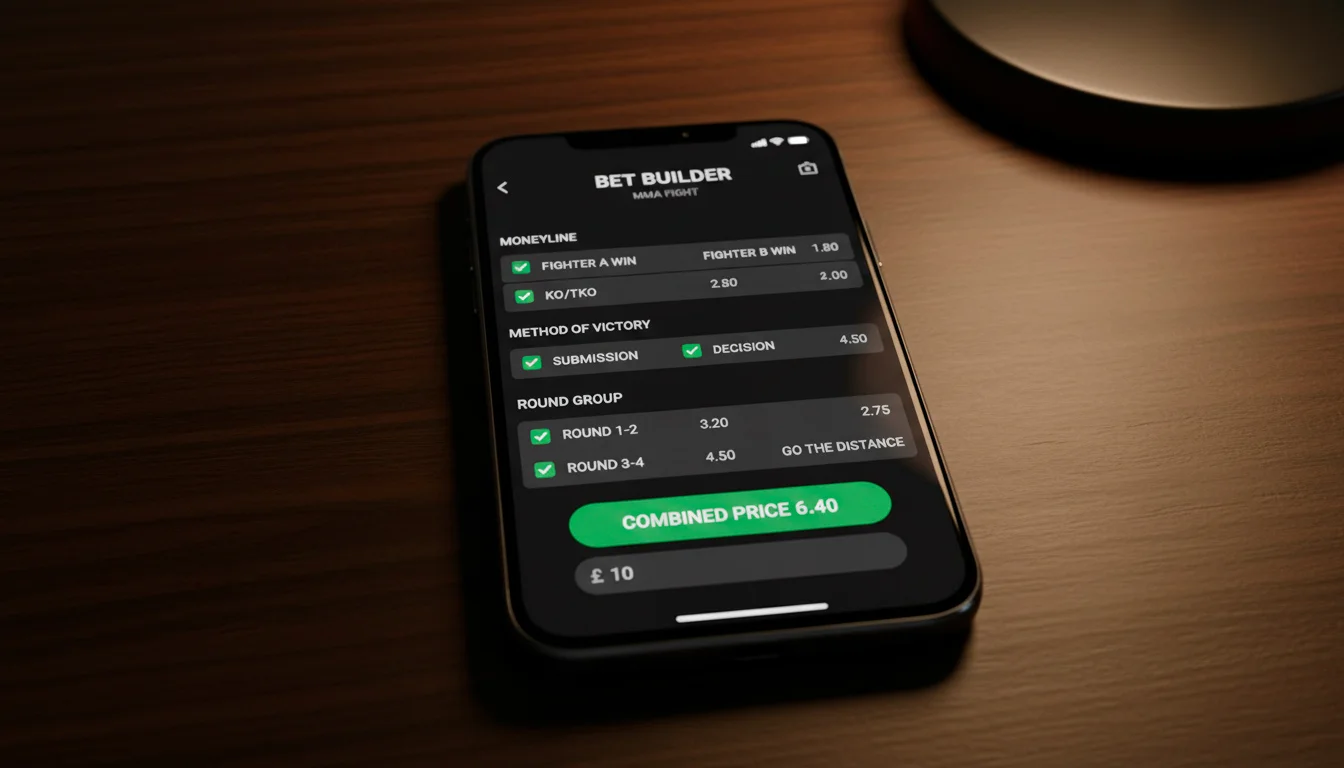
Bet builders are marketed at UK punters like a gateway drug. Open the app, pick three or four outcomes from the same fight, tap the big green button, and watch the price balloon to something that would never exist as a single-market bet. 1.45 times 1.90 times 2.30 equals 6.33 — except not really, because the sportsbook’s correlation engine has been doing maths in the background that most punters never see. The displayed price is rarely what pure multiplication would give you, and understanding why that is makes the difference between using this market well and bleeding money through it every fight card.
I’ve watched bet builders evolve from a gimmick — the kind of thing people used to combine a goal and a card in football — into the single most pushed product on UK sportsbook apps during UFC events. There’s a reason for that, and it’s not that punters are suddenly winning more.
How a UFC Bet Builder Assembles a Price
The base of a bet builder is usually simple multiplication. Pick a moneyline, a method of victory, and a round — say, Fighter A to win, by KO/TKO, in rounds 1-2 — and the book’s first cut at a price is the product of those three individual market prices minus its margin. But as soon as you stack two outcomes that aren’t independent of each other, the book’s pricing engine kicks in and adjusts the number downward.
Here’s the logic. “Fighter A wins” and “fight ends by KO” are not independent events — if Fighter A is known as a knockout artist, then the probability that both happen is higher than simple multiplication would suggest. The sportsbook knows this, so it shortens the price to account for the correlation. What you see in the app is the adjusted price, not the raw multiplication. The correlation adjustment is where the book claws back value that a naive punter might assume they were getting.
Different UK operators run different pricing engines and apply correlation adjustments with different levels of aggression. The same three selections might price at 5.80 on one sportsbook and 6.20 on another — not because one has higher margins overall, but because the correlation weighting differs. That’s one reason line shopping matters even within bet builders, though the comparison is harder than it is for singles.
Correlation: Why Your Odds Aren’t Simple Multiplication
Correlation cuts both ways, and understanding which direction it’s cutting is the single most useful skill a bet builder punter can develop. Positive correlation is when two selections tend to happen together more often than pure chance would predict. Negative correlation is when they tend to happen apart.
Examples of positive correlation in UFC: Fighter A to win moneyline + Fighter A to win by KO. If the moneyline hits, the probability of a KO is conditional on A winning, so the combined probability is higher than multiplying the two together. Fighter A to win + fight under 2.5 rounds. If the fighter is a finisher, the under is more likely given they win. These are the combinations where the sportsbook shortens your price because the correlation is working in your favour from the book’s point of view — and the adjustment protects the book’s margin.
Examples of negative correlation: Fighter A to win by decision + fight under 2.5 rounds. These are essentially contradictory. A decision can’t happen inside 2.5 rounds under standard UFC rules. So either the combination is literally impossible (and the book simply won’t let you select it), or the book will flag it and offer to rewrite it for you. Fighter A to win + fight ends by submission, when Fighter A has zero submissions in their career. Not impossible, but very weakly correlated, so the book might leave the simple-multiplication price closer to untouched — that’s the math that favours 72% UFC favourites winning in 2024 but says nothing about how.
The sharp play is to build combinations where the individual legs are plausibly independent or mildly positively correlated, and where the book’s correlation adjustment is less aggressive than it should be. The foolish play is to throw together whatever narrative fits the matchup without checking whether the legs make sense together.
Common Combo Patterns That Work on UFC
The pattern I use most is “moneyline + goes distance yes” on matchups where the favourite is a controlling grappler against a durable striker. The moneyline might be 1.50, the “goes distance yes” might be 2.20, and the correlated price in the bet builder often settles around 2.80 to 3.00 depending on the operator. That’s a better number than backing the moneyline alone at 1.50, and the underlying read — controlling grappler decisions against a chin — is a high-probability outcome when the matchup fits.
Another one: “moneyline + fight ends rounds 3-5” on five-round main events where the favourite has a cardio advantage. Moneyline 1.70, rounds 3-5 finish at 4.50, bet builder combined at roughly 5.00. The read here is that the favourite wins but only after the opponent fades, so the finish lives in the late rounds. When the style read is accurate, this combination is meaningfully higher-EV than either leg alone.
A combination I avoid, even when the narrative seems to fit, is “underdog moneyline + method of KO + specific round.” Three legs on an underdog stacks the negative EV of each leg and the correlation adjustment often doesn’t compensate enough to make the combined price a real bargain. You’d need to be right on all three in a scenario where you were already long against the market. UFC underdogs win around 35% of fights, but underdog KOs in a specific round are a much rarer subset of that.
The usable heuristic: two legs with clear positive correlation in favour of a chalky read tend to produce the best bet-builder value. Three legs adds risk without adding edge. Four legs is usually marketing dressed up as strategy.
Traps: When a Builder Looks Cheap but Isn’t
The first trap is mistaking a big combined price for value. 8.00 on a four-leg builder is not automatically a good bet. If the true combined probability is 10%, you need the price to be above 10.00 to break even on margin, and you’re almost certainly looking at something the book has priced with its standard overround plus correlation adjustments. The 8.00 just looks exciting relative to the moneyline.
The second trap is forgetting that UFC underdogs win around 35% of the time but specific underdog combinations — a finish in a specific round by a specific method — live in the single-digit-percentage range. When you start multiplying longshot legs, your combined probability crashes fast, and the resulting price is long but still carries the book’s full margin stack.
The third trap is operator-specific correlation treatment. One UK book might treat “Fighter A wins + over 2.5 rounds” as essentially independent and price it close to simple multiplication. Another might recognise that Fighter A is a decision-heavy fighter and shorten the price aggressively. The same bet on different books can differ by 20-30% in price. Always check two or three operators before committing, especially on correlated combinations.
The fourth trap is the “one more leg” temptation. Three legs at 4.80. Add a fourth leg at 1.40 — harmless, right? — and the price jumps to 6.40. The problem is that every leg you add multiplies the probability of failure, and a 1.40 leg that sounds nearly guaranteed still has a 28% miss rate. Every month I see readers message about bet builders that hit three out of four legs and pay nothing, when a three-leg version of the same ticket would have cashed. Discipline on leg count is the single biggest driver of long-term bet-builder performance.
Why UK Bookmakers Price the Same Builder Differently
The pricing engines behind UK bet builders are proprietary. Every operator has its own model, its own view on which markets correlate and by how much, its own margin policy, and its own appetite for exotic combinations. So even for identical legs, the displayed price differs.
I’ve seen the same three-leg UFC bet builder quoted at 5.80 on one operator, 6.40 on another, and 6.80 on a third. That’s the difference between three operators with varying views on UFC correlation and varying margin policies. Over a year of bet builder activity, choosing the best price on every ticket is the difference between a losing punter and a break-even one.
Some UK books cap bet-builder stakes aggressively because the combined markets carry more settlement risk. You might see a maximum stake of £10 or £25 on a four-leg UFC builder, versus £200+ on a straight moneyline bet. The cap protects the book from a punter who has genuinely figured out a mispriced combination. It also limits your ability to press an edge when you find one, which is a structural feature of the market — not a bug you can engineer around.
Bet builder rules on voided legs also vary. If one of your legs gets ruled a no contest, some operators recalculate the price with the remaining legs and pay out if they hit. Others void the entire ticket. This is fine print that matters, especially on UFC cards where a fighter might miss weight on Friday and one of your legs (catchweight-dependent) becomes contentious. Know your operator’s policy before you build tickets you care about. If nothing else, use the simpler moneyline market for stakes where settlement certainty matters more than the bigger displayed price.
Before the Next Build Slip Opens
Bet builders are the most seductive market on a UFC card and the one where the gap between “feels like value” and “is value” is widest. The correlation adjustments the book applies are invisible to you but mathematically decisive — they eat the value a naive punter thinks they’re getting from stacking legs. Understanding which combinations the book is pricing conservatively and which it’s pricing aggressively is the only real edge in this market.
Keep leg counts low. Prefer two or three over four or five. Build around clear positive correlation in favour of a chalky read. Compare prices on at least two operators. Know the rules for voided legs before you stake meaningful money. And never let the size of the combined price distract you from the underlying probability of it actually hitting. That’s the whole game.
Why do UFC bet builder prices differ between bet365 and Sky Bet?
Each UK operator runs its own correlation model. The same three legs can price differently because the books disagree on how tightly the markets correlate, apply margin policies differently, and update prices at different cadences. Shopping between two or three UKGC-licensed operators before placing a builder ticket is standard discipline.
Does adding a correlated leg always lower the overall price?
Yes. Positive correlation means the combined probability of both legs hitting is higher than pure multiplication would give, so the book shortens the combined price to account for that. The correlation adjustment protects the book’s margin and is the reason bet builder prices are rarely as generous as the raw multiplication of individual lines.
Written by the editors at ufc bet Online.