UFC Betting Glossary: 40 Terms Every UK Punter Should Know
 Available in US
A reader messaged me recently asking what “CLV” meant. He’d been reading UFC betting Twitter for six months and had absorbed about 40% of what he was seeing, but the rest was a wall of jargon he was too embarrassed to ask about. That’s the problem with specialist vocabulary — once you’re inside it, you stop noticing, and once you’re outside it, you can’t easily cross the border. This glossary fixes that for UK UFC betting specifically.
I’ve tried to cover the terms that actually come up in real punter conversations, not the ones that fill up textbooks. Some are universal to sports betting. Some are specific to MMA. Some are British regulatory vocabulary that American or European guides wouldn’t include. The common thread is that if you spend time around UK UFC betting — forums, podcasts, Telegram groups, operator apps — these are the terms you’ll encounter often enough that not knowing them creates friction.
Market Terms
Moneyline. The simplest bet in UFC — pick which fighter wins, regardless of how. Also called “outright” on some UK operators. UFC favourites won 72% of fights in 2024, which calibrates expectations around moneyline hit rates.
Method of victory. A bet on how the fight ends — KO/TKO, submission, or decision. Usually priced as a six-way market (each fighter with each method).
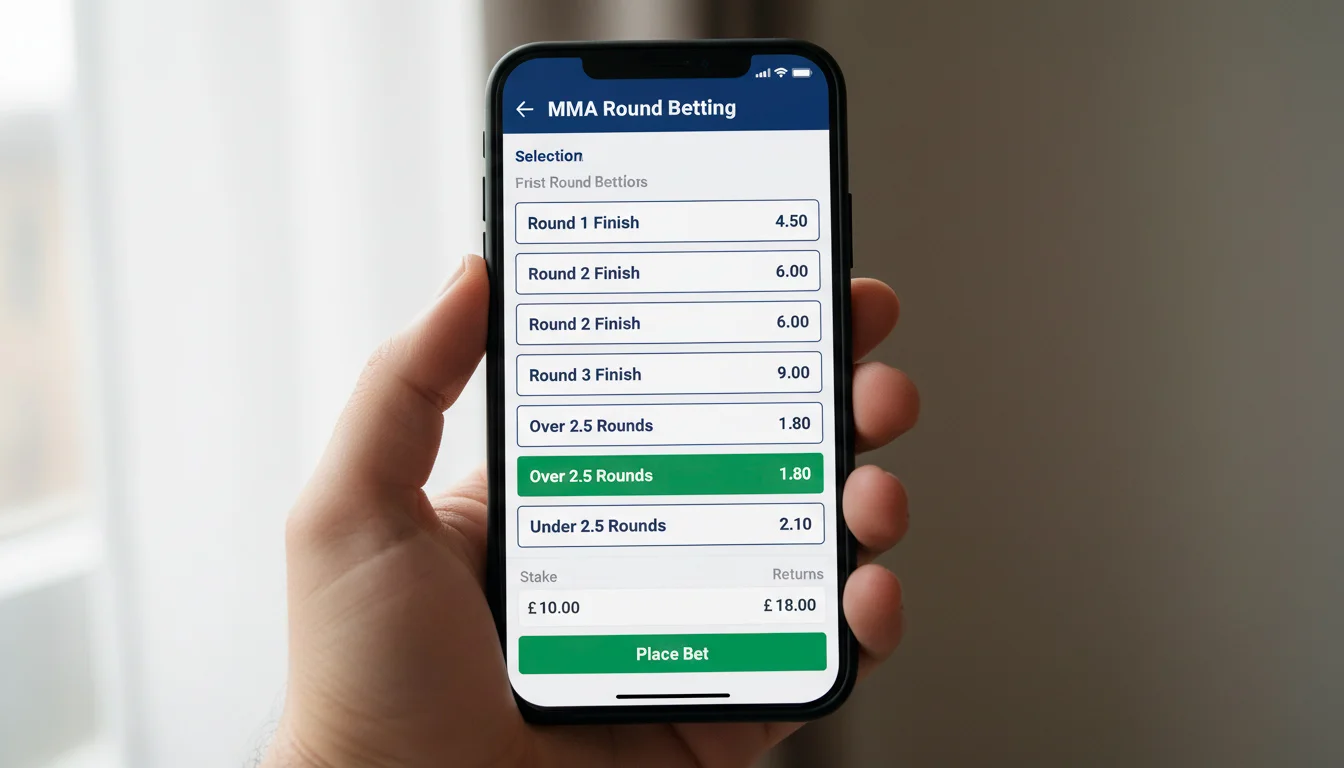
Round betting. Betting on which specific round the fight ends in, or on a group of rounds (e.g., “rounds 1-2 finish”).
Over/under rounds. Betting on total rounds completed. Over/Under 2.5 means the fight must reach 2:30 of round three to hit the over.
Bet builder. A combined bet within the same fight — multiple markets (moneyline + method + round, for example) priced together with correlation adjustments. Also called “same-game parlay” in American books, though the UK operators branded it “bet builder” first.
Prop bet. A proposition bet on a specific event outcome — fight of the night, performance of the night, total takedowns. Distinct from the main betting markets.
Accumulator (acca). A multi-bet ticket across multiple fights. All selections must win for the accumulator to pay. British shorthand “acca” is standard.
Cash out. Settling a live bet before the fight ends at a partial payout the operator offers. Usually costs 10-15% of theoretical value in margin.
In-play. Betting during a live fight rather than before. UK punters place 74% of in-play wagers on phones or tablets.
Futures. Long-term bets on outcomes that resolve months away — division champion by year-end, fighter of the year, that sort of thing.
Pricing and Value Terms
Decimal odds. The standard UK odds format. Multiply your stake by the decimal odds to get total return (including stake). 2.50 means £10 stake returns £25.
Implied probability. 1 divided by decimal odds. A price of 2.50 implies 40% probability. Useful for comparing the book’s estimate against your own.
Overround. The sportsbook’s margin expressed as the sum of implied probabilities on all outcomes. UFC main events typically run 103-108% overround.
Juice / vig. Another term for the overround, especially in American betting vocabulary. The book’s cut for taking action.
Closing line value (CLV). The difference between the price you bet at and the price the fight closed at. Positive CLV predicts long-run profitability better than any other single metric.
Line movement. Changes in the price between opening and closing. Heavy movement in one direction indicates sharp money, heavy injury news, or weigh-in developments.
Steam. A sudden rapid movement in odds, usually driven by sharp action or breaking news. If you see “steam” on a fight, the price is moving fast and recreational punters are chasing.
Sharp money. Bets from known professional punters or syndicates. Sportsbooks track who the sharp money is and adjust lines when it comes in.
Overlay. A bet where your estimated probability exceeds the implied probability — positive expected value. The opposite is “underlay”.
Push. A bet that results in stake return rather than win or loss. Rare in UFC but can happen on exact round totals that land on the half-round line (though the 2.5 or 3.5 phrasing avoids this).
MMA-Specific Terms
Chalk. The favourite. Backing chalk is betting on the clear favourite.
Dog / longshot. The underdog. UFC underdogs win approximately 35% of fights historically.
Pick’em. A fight where both fighters are priced at similar odds (typically 1.90-2.00). No clear favourite.
KO/TKO. Knockout or technical knockout. UFC bundles both into one method-of-victory category. TKOs include corner stoppages, doctor stoppages, and referee waves-off from strikes.
Submission. A finish where a fighter taps out or goes unconscious from a submission hold. Includes verbal submissions and technical submissions.
Split decision / unanimous decision / majority decision. Three types of judges’ decisions. Unanimous = all three judges for one fighter. Split = two judges for one fighter, one for the other. Majority = two for one fighter, one sees a draw.
No contest. A fight ruled as neither a win nor a loss for either fighter, usually because of an illegal foul causing a stoppage. Voids most moneyline bets on UK books.
Catchweight. A fight contracted at a non-standard weight, usually because one fighter missed their original weight class. UK books typically honour moneyline bets on catchweight fights.
SLpM / SApM. Significant Strikes Landed per Minute and Significant Strikes Absorbed per Minute. Core striking stats for handicapping. A 72% win rate attaches to fighters with superior overall striking stats.
Fight of the Night (FOTN) / Performance of the Night (POTN). UFC bonus categories awarded post-event. Dana White announces them at the press conference; prop markets settle on the announcement.
UK Regulation Terms
UKGC. UK Gambling Commission. The regulator overseeing all licensed gambling operators in Great Britain. Licenses 2,179 operators and approximately 19,300 personal licence holders as of March 2025.
BGC. Betting and Gaming Council. Industry trade body representing licensed UK bookmakers and gambling operators.
Remote Gaming Duty (RGD). The tax on online casino and slot revenue. Rising from 21% to 40% on 1 April 2026.
General Betting Duty. The tax on sports betting revenue. A new higher-rate 25% duty applies to remote bets from April 2026.
Statutory levy. A mandatory contribution by UK gambling operators (0.1-1.1% of GGY) funding research, prevention, and treatment of gambling harm. Took effect 6 April 2025.
GGY. Gross Gambling Yield. The difference between what operators take in and what they pay out to winners. UK GGY reached £16.8 billion in the financial year April 2024 to March 2025.
Financial vulnerability check. A light-touch affordability review triggered at £150 net deposits per rolling 30-day period. Applied at operator level.
KYC. Know Your Customer. Identity verification required by UK operators before withdrawals and often at account opening.
GamStop. National self-exclusion scheme for UK gambling. Registering blocks you from all UKGC-licensed operators for a chosen period.
Affordability. Checks an operator conducts to verify that a punter’s betting volume is sustainable relative to their financial position. The 2025 threshold of £150 is the primary trigger.
Coming back to terms you’ll likely see in UK punter forums that aren’t in this list — if you’re reading a post and someone uses a term nobody explains, the context usually makes it guessable. This glossary covers about 80% of the vocabulary that comes up in UK UFC betting discussion; the rest emerges through exposure. The markets framework is the deeper explanation behind how these terms apply in practice to specific bet types.
The Vocabulary That Reduces Friction
UK UFC betting carries a double layer of specialist vocabulary — sports betting terms that apply across all markets, plus MMA-specific terminology that doesn’t transfer from other sports, plus UK regulatory language that doesn’t apply outside the UK. Reading forums, listening to podcasts, and using operator apps all move faster once the core 40 terms are familiar.
The glossary won’t make you a better punter on its own. But it removes the friction of pausing on unfamiliar phrases, which means you can focus mental energy on the actual analytical work. That shift — from “what does this word mean” to “does this argument make sense” — is the quiet upgrade that regular exposure to UK UFC betting produces, and knowing the vocabulary is where it starts.
What’s the difference between ‘steam’ and ‘sharp action’ in UFC markets?
Sharp action is bets placed by known professional punters or syndicates — the sportsbook tracks who the sharp money is and weights its line adjustments accordingly. Steam is the resulting visible price movement when sharp action combined with public action pushes a line rapidly in one direction. Sharp action is the cause; steam is the observable effect on the odds board.
Does ‘push’ ever happen in UFC totals betting?
Rarely, because UK books use half-round thresholds (2.5, 3.5) that avoid exact ties. The fight either reaches 2:30 of round three or it doesn’t — no ambiguity. Where pushes can occur is on fights voided by no-contest rulings, which return stakes rather than paying out. Some prop markets with integer thresholds can push, but standard UFC totals rarely do.
Written by the editors at ufc bet Online.